
|
You entered: light
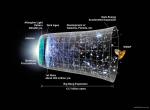 Inflating the Universe
23.03.2006
The Universe is expanding gradually now. But its initial expansion was almost impossibly rapid as it likely grew from quantum scale fluctuations in a trillionth of a second. In fact, this cosmological scenario, known as Inflation, is now reported to be further quantified by an analysis of three years of data from the WMAP spacecraft.
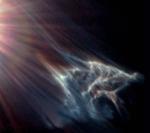 Reflecting Merope
15.07.2006
(xxxedit and linkxxx) In the well known Pleiades star cluster, starlight is slowly destroying this wandering cloud of gas and dust. The star Merope lies just off the upper left edge of this picture from the Hubble Space Telescope.
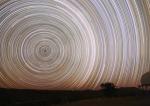 11 Hour Star Trails
15.09.2006
Fix your camera to a tripod, lock the shutter open, and you can make an image of star trails - graceful concentric arcs traced by the stars as planet Earth rotates on its axis. Of course, the length of the star trails will depend on the exposure time.
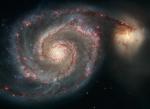 M51: Cosmic Whirlpool
11.11.2006
Follow the handle of the Big Dipper away from the dipper's bowl, until you get to the handle's last bright star. Then, just slide your telescope a little south and west and you might find this stunning pair of interacting galaxies, the 51st entry in Charles Messier's famous catalog.
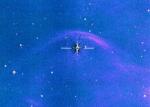 Runaway Star
27.11.1999
Runaway stars are massive stars traveling rapidly through interstellar space. Like a ship plowing through the interstellar medium, runaway star HD 77581 has produced this graceful arcing bow wave or "bow shock" - compressing the gaseous material in its path.
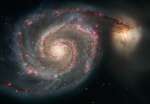 M51: Cosmic Whirlpool
5.01.2008
Follow the handle of the Big Dipper away from the dipper's bowl, until you get to the handle's last bright star. Then, just slide your telescope a little south and west and you might find this stunning pair of interacting galaxies, the 51st entry in Charles Messier's famous catalog.
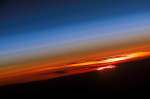 Sunset: Planet Earth
20.03.2008
Today, the Sun crosses the celestial equator heading north at 0548 UT. Known as the equinox, the geocentric astronomical event marks the first day of spring in the northern hemisphere and autumn in the south.
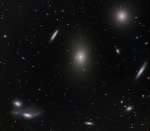 M86 in the Virgo Cluster
25.04.2008
Bright lenticular galaxy M86 is near center of this cosmic view, at the heart of the Virgo Galaxy Cluster. Other bright galaxies in the neighborhood include M84 at the upper right, edge-on spiral NGC4388...
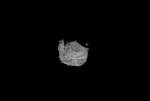 Rosetta Approaches Comet Churyumov Gerasimenko
11.08.2014
What does it look like to approach a comet? Early this month humanity received a new rendition as the robotic Rosetta spacecraft went right up to -- and began orbiting -- the nucleus of Comet 67P/Churyumov-Gerasimenko.
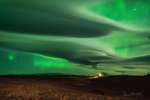 Aurora over Clouds
24.11.2015
Auroras usually occur high above the clouds. The auroral glow is created when fast-moving particles ejected from the Sun impact the Earth's magnetosphere, from which charged particles spiral along the Earth's magnetic field to strike atoms and molecules high in the Earth's atmosphere.
|
January February March April May June July August September October |
|||||||||||||||||||||||||||||||||||||||||||||||||