
|
You entered: light
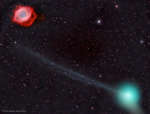 Comet PanSTARRS and the Helix Nebula
5.06.2016
It's rare that such different objects are imaged so close together. Such an occasion is occurring now, though, and was captured two days ago in combined parallel exposures from the Canary Islands of Spain.
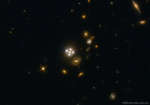 Four Quasar Images Surround a Galaxy Lens
27.02.2017
An odd thing about the group of lights near the center is that four of them are the same distant quasar. This is because the foreground galaxy -- in the center of the quasar images and the featured image -- is acting like a choppy gravitational lens.
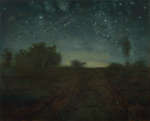 Starry Night by Jean Franцois Millet
13.03.2020
A dramatic nocturnal landscape from around 1850, this oil painting is the work of French artist Jean-Francois Millet. In the dark and atmospheric night sky are shooting stars, known too as meteors, above a landscape showing a path through the faintly lit countryside that leads toward trees and a cart in silhouette on the horizon.
 Cosmic Latte: The Average Color of the Universe
27.12.2020
What color is the universe? More precisely, if the entire sky were smeared out, what color would the final mix be? This whimsical question came up when trying to determine what stars are commonplace in nearby galaxies. The answer, depicted above, is a conditionally perceived shade of beige. In computer parlance: #FFF8E7.
 APOD: 2024 July 17 Б Villarrica Volcano Against the Sky
17.07.2024
When Vulcan, the Roman god of fire, swings his blacksmith's hammer, the sky is lit on fire. A recent eruption of Chile's Villarrica volcano shows the delicate interplay between this fire -- actually...
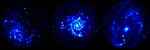 A Spiral Galaxy Gallery
14.03.1998
A progression of beautiful spiral galaxies is illustrated above with three photographs from NASA's Ultraviolet Imaging Telescope (UIT). Flying above the Earth's obscuring layer of atmosphere on the Space Shuttle Columbia during...
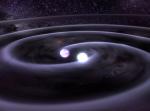 White Dwarf Star Spiral
1.06.2005
About 1,600 light-years away, in a binary star system fondly known as J0806, two dense white dwarf stars orbit each other once every 321 seconds. Interpreting x-ray data from the Chandra Observatory astronomers argue that the stars' already impressively short orbital period is steadily getting shorter as the stars spiral closer together.
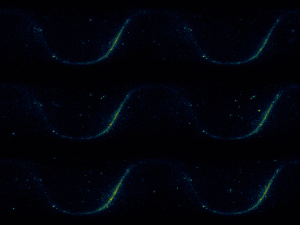 Simulated Gamma ray Sky
31.05.2006
Scheduled for launch in 2007, the Gamma-ray Large Area Space Telescope (GLAST) will explore the Universe in gamma-rays, the most energetic form of light. To get ready, consider this dynamic gamma-ray sky animation - constructed from simulating the first 55 days (seen above at one frame per day) of GLAST observations of cosmic gamma-ray sources.
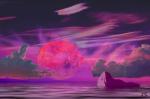 Sunrise from the Surface of Gliese 581c
2.05.2007
How might a sunrise appear on Gliese 581c? One artistic guess is shown above. Gliese 581c is the most Earth-like planet yet discovered and lies a mere 20 light-years distant. The central red dwarf...
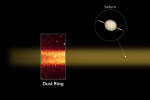 Giant Dust Ring Discovered Around Saturn
13.10.2009
What has created a large dust ring around Saturn? At over 200 times the radius of Saturn and over 50 times the radius of Saturn's expansive E ring, the newly discovered dust ring is the largest planetary ring yet imaged. The ring was found in infrared light by the Earth-orbiting Spitzer Space Telescope.
|
January February March April May June July August September October |
|||||||||||||||||||||||||||||||||||||||||||||||||