
|
You entered: light
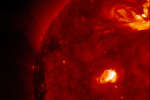 A Jet from the Sun
10.12.2007
What powers the solar wind? Our Sun is known to emit a powerful wind of particles with gusts that can even affect astronauts and satellites orbiting Earth. The cause of the solar wind...
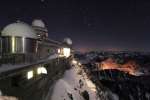 Winter Night at Pic du Midi
25.01.2008
This dreamlike view looking south from the historic mountain top Pic du Midi Observatory combines moonlit domes, a winter night sky, and the snowy peaks of the French Pyrenees. Encroaching on the night, lights...
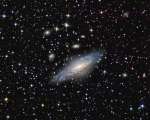 NGC 7331 and Beyond
12.07.2008
Big, beautiful spiral galaxy NGC 7331 is often touted as an analog to our own Milky Way. About 50 million light-years distant in the northern constellation Pegasus, NGC 7331 was recognized early on as a spiral nebula and is actually one of the brighter galaxies not included in Charles Messier's famous 18th century catalog.
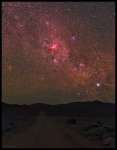 On the Road to Carina
18.02.2012
This rugged road through the dark Atacama Desert seems to lead skyward toward the bright stars and glowing nebulae of the southern Milky Way. If you follow the road you will get to Cerro Armazones peak in Chile, future construction site for the 40-meter class European Extremely Large Telescope.
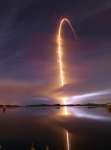 RBSP Night Launch
2.09.2012
This graceful arc traces a Delta rocket climbing through Thursday's early morning skies over Cape Canaveral Air Force Station in Florida, USA. Snug inside the rocket's Centaur upper stage were NASA's twin Radiation Belt Storm Probes (RBSP), now in separate orbits within planet Earth's Van Allen radiation belts.
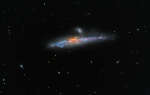 NGC 4631: The Whale Galaxy
3.06.2016
NGC 4631 is a big beautiful spiral galaxy. Seen edge-on, it lies only 25 million light-years away in the well-trained northern constellation Canes Venatici. The galaxy's slightly distorted wedge shape suggests to some a cosmic herring and to others its popular moniker, The Whale Galaxy.
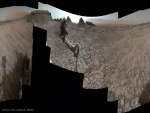 Curiosity at Murray Buttes on Mars
24.08.2016
What are these unusual lumps on Mars? As NASA's robotic Curiosity rover continues rolling across Mars, it is now approaching Murray Buttes. Several of the 15-meter high buttes are visible ahead in this horizontally compressed 360-degree across image taken inside Gale Crater earlier this month.
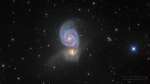 M51: The Whirlpool Galaxy
19.10.2017
Find the Big Dipper and follow the handle away from the dipper's bowl until you get to the last bright star. Then, just slide your telescope a little south and west and you'll come upon this stunning pair of interacting galaxies, the 51st entry in Charles Messier's famous catalog.
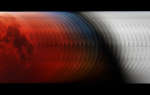 Into the Shadow
24.01.2020
On January 21, 2019 moonwatchers on planet Earth saw a total lunar eclipse. In 35 frames this composite image follows the Moon that night as it crossed into Earth's dark umbral shadow. Taken...
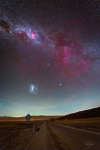 The Gum Nebula Supernova Remnant
29.11.2022
Because the Gum Nebula is the closest supernova remnant, it is actually hard to see. Spanning 40 degrees across the sky, the nebula appears so large and faint that it is easily lost in the din of a bright and complex background.
|
January February March April May June July August September October |
|||||||||||||||||||||||||||||||||||||||||||||||||