
|
You entered: light
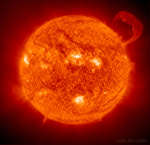 A Solar Prominence from SOHO
30.01.2022
How can gas float above the Sun? Twisted magnetic fields arching from the solar surface can trap ionized gas, suspending it in huge looping structures. These majestic plasma arches are seen as prominences above the solar limb.
 APOD: 2025 May 9 Б IXPE Explores a Black Hole Jet
9.05.2025
How do black holes create X-rays? Answering this long-standing question was significantly advanced recently with data taken by NASAБs IXPE satellite. X-rays cannot exit a black hole, but they can be created in the energetic environment nearby, in particular by a jet of particles moving outward.
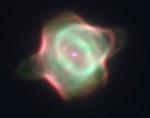 Hen 1357: New Born Nebula
6.10.2001
This Hubble Space Telescope snapshot shows Hen-1357, the youngest known planetary nebula. Graceful, gentle curves and symmetry suggest its popular name - The Stingray Nebula. Observations in the 1970s detected no nebular material, but this image from March 1996 clearly shows the Stingray's emerging bubbles and rings of shocked and ionized gas.
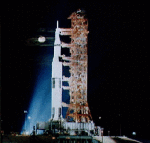 The Last Moon Shot
9.09.1995
In 1865 Jules Verne predicted the invention of a space capsule that could carry people. In his science fiction story "From the Earth to the Moon", he outlined his vision of constructing a cannon in Florida so powerful that it could shoot a "Projectile-Vehicle" carrying three adventurers to the Moon.
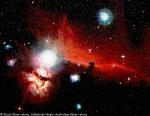 Orion's Horsehead Nebula
2.10.1996
The Horsehead Nebula is arguably the most famous nebula on the sky. It is visible as the black indentation to the red emission nebula seen just to the right of center of the above photograph. The bright star near the center is located in the belt of the familiar constellation of Orion.
 Infrared Helix
1.09.1997
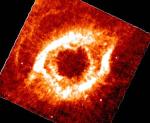
Five hundred light years from Earth, in the constellation Aquarius, a sun-like star is dying. Its last few thousand years have produced the Helix, a well studied and nearby example of a Planetary Nebula - typical of this final phase of stellar evolution.
 The Colorful Horsehead Nebula
7.10.2003
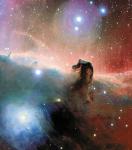
While drifting through the cosmos, a magnificent interstellar dust cloud became sculpted by stellar winds and radiation to assume a recognizable shape. Fittingly named the Horsehead Nebula, it is embedded in the vast and complex Orion Nebula.
 The Hercules Cluster of Galaxies
27.04.2005
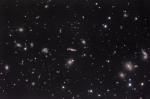
These are galaxies of the Hercules Cluster, an archipelago of "island universes" a mere 650 million light-years distant. This cluster is loaded with gas and dust rich, star forming, spiral galaxies but has relatively few elliptical galaxies, which lack gas and dust and the associated newborn stars.
 M1: The Crab Nebula from Hubble
25.12.2011
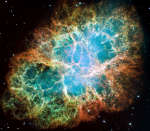
This is the mess that is left when a star explodes. The Crab Nebula, the result of a supernova seen in 1054 AD, is filled with mysterious filaments. The filaments are not only tremendously complex, but appear to have higher speed than expected from a free explosion.
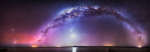 From the Northern to the Southern Cross
27.01.2014
There is a road that connects the Northern to the Southern Cross but you have to be at the right place and time to see it. The road, as pictured above, is actually...
|
January February March April May June July August September October |
|||||||||||||||||||||||||||||||||||||||||||||||||