
|
You entered: light
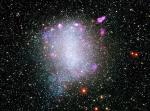 Local Group Galaxy NGC 6822
22.01.2002
Nearby galaxy NGC 6822 is irregular in several ways. First, the galaxy's star distribution merits a formal classification of dwarf irregular, and from our vantage-point the small galaxy appears nearly rectangular. What strikes...
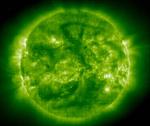 S is for Sun
20.03.2002
Taken yesterday from the SOHO spacecraft, this false-color image shows the active Sun near the March Equinox, the beginning of Fall in the south and Spring in the northern hemisphere. Recorded in a band...
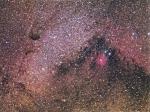 M24: A Sagittarius Starscape
21.09.2004
Many vast star fields in the plane of our Milky Way Galaxy are rich in clouds of dust, and gas. First and foremost, visible in the above picture are millions of stars, many of which are similar to our Sun.
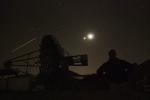 VERITAS and Venus
7.11.2007
Early morning risers and late to bed astronomers have recently enjoyed bright planets in predawn skies, with brilliant Venus above the eastern horizon. On November 5, Venus was joined by the waning crescent Moon.
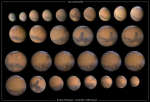 Changes in Angular Mars
14.07.2008
Does Mars always appear the same? No. As both Earth and Mars orbit the Sun, the apparent angular size of Mars changes as viewed from the Earth. Pictured above from Enschede, Holland, Mars was captured in 2007 and 2008 with 30 separate images, all taken with the same magnification.
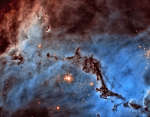 N11: Star Clouds of the LMC
11.02.2013
Massive stars, abrasive winds, mountains of dust, and energetic light sculpt one of the largest and most picturesque regions of star formation in the Local Group of Galaxies. Known as N11, the region...
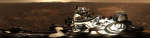 Mars Perseverance Sol 3
25.02.2021
Stitched together on planet Earth, 142 separate images make up this 360 degree panorama from the floor of Jezero Crater on Mars. The high-resolution color images were taken by the Perseverance rover's zoomable Mastcam-Z during mission sol 3, also known as February 21, 2021.
 APOD: 2025 February 25 Б M41: The Little Beehive Star Cluster
24.02.2025
Why are there so many bright blue stars? Stars are usually born in clusters, and the brightest and most massive of these stars typically glow blue. Less-bright, non-blue stars like our Sun surely also exist in this M41 star cluster but are harder to see. A few bright orange-appearing red giant stars are visible.
 APOD: 2025 August 3 Б Milky Way and Exploding Meteor
2.08.2025
In about a week the Perseid Meteor Shower will reach its maximum. Grains of icy rock will streak across the sky as they evaporate during entry into Earth's atmosphere. These grains were shed from Comet Swift-Tuttle.
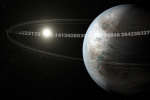 APOD: 2026 March 14 Б A Year for K2-315b
13.03.2026
Want to visit a planet that has 3.14 days in a year? Then plan a trip to K2-315b, an earth-sized planet orbiting around a cool, red, M dwarf star about once every 3.14 days.
|
January February March April May June July August September October |
|||||||||||||||||||||||||||||||||||||||||||||||||