
|
You entered: light
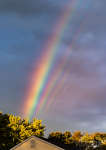 Supernumerary Rainbows over New Jersey
2.10.2018
Yes, but can your rainbow do this? After the remnants of Hurricane Florence passed over Jersey Shore, New Jersey, USA last month, the Sun came out in one direction but something quite unusual appeared in the opposite direction: a hall of rainbows.
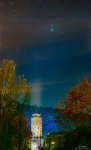 December s Comet Wirtanen
7.12.2018
Coming close in mid-December, Comet 46P Wirtanen hangs in this starry sky over the bell tower of a Romanesque church. In the constructed vertical panorama, a series of digital exposures capture its greenish coma on December 3 from Sant Llorenc de la Muga, Girona, Catalonia, Spain, planet Earth.
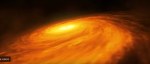 Animation: Spiral Disk around a Black Hole
20.08.2019
What would it look like to orbit a black hole? Many black holes are surrounded by swirling pools of gas known as accretion disks. These disks can be extremely hot, and much of the orbiting gas will eventually fall through the black hole's event horizon -- where it will never been seen again.
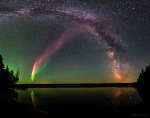 A Glowing STEVE and the Milky Way
17.11.2020
What's creating these long glowing streaks in the sky? No one is sure. Known as Strong Thermal Emission Velocity Enhancements (STEVEs), these luminous light-purple sky ribbons may resemble regular auroras, but recent research reveals significant differences.
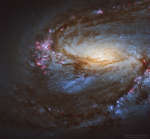 Spiral Galaxy M66 from Hubble
24.02.2021
ItБs always nice to get a new view of an old friend. This stunning Hubble Space Telescope image of nearby spiral galaxy M66 is just that. A spiral galaxy with a small central bar, M66 is a member of the Leo Galaxy Triplet, a group of three galaxies about 30 million light years from us.
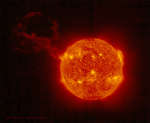 Record Prominence Imaged by Solar Orbiter
2.03.2022
What's happened to our Sun? Last month, it produced the largest prominence ever imaged together with a complete solar disk. The record image, featured, was captured in ultraviolet light by the Sun-orbiting Solar Orbiter spacecraft.
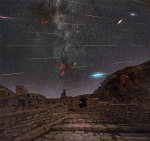 A Meteor Wind over Tunisia
16.08.2022
Does the Earth ever pass through a wind of meteors? Yes, and they are frequently visible as meteor showers. Almost all meteors are sand-sized debris that escaped from a Sun-orbiting comet or asteroid, debris that continues in an elongated orbit around the Sun.
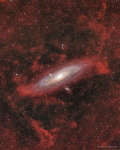 Clouds Around Galaxy Andromeda
24.10.2022
What are those red clouds surrounding the Andromeda galaxy? This galaxy, M31, is often imaged by planet Earth-based astronomers. As the nearest large spiral galaxy, it is a familiar sight with dark dust lanes, bright yellowish core, and spiral arms traced by clouds of bright blue stars.
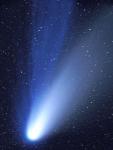 The Dust and Ion Tails of Comet Hale Bopp
27.12.2000
In 1977, Comet Hale-Bopp's intrinsic brightness exceeded any comet since 1811. Since it peaked on the other side of the Earth's orbit, however, the comet appeared only brighter than any comet in two decades. Visible above are the two tails shed by Comet Hale-Bopp.
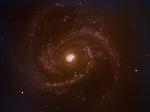 A Nearby Supernova in Spiral Galaxy M100
7.03.2006
One of the nearer supernovas of recent years was discovered last month in the bright nearby galaxy M100. The supernova, dubbed SN 2006X, is still near its maximum brightness and visible with a telescope...
|
January February March April May June July August September October |
|||||||||||||||||||||||||||||||||||||||||||||||||