
|
You entered: light
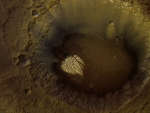 Mysterious White Rock Fingers on Mars
7.04.2008
What caused this unusual white rock formation on Mars? Intrigued by the possibility that they could be salt deposits left over as an ancient lakebed dried-up, detailed studies of these fingers now indicate that this is not correct.
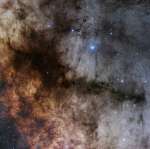 The Pipe Nebula
23.11.2012
East of Antares, dark markings sprawl through crowded star fields toward the center of our Milky Way Galaxy. Cataloged in the early 20th century by astronomer E. E. Barnard, the obscuring interstellar dust clouds include B59, B72, B77 and B78, seen in silhouette against the starry background.
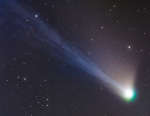 Tails of Comet Lemmon
6.05.2013
What caused the interestingly intricate tails that Comet Lemmon displayed earlier this year? First of all, just about every comet that nears the Sun displays two tails: a dust tail and an ion tail.
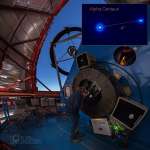 At the Limit of Diffraction
6.05.2015
Did you ever want to just look through the eyepiece of a large telescope in space? If you could, you would see a sharp view that was diffraction limited. Unaffected by atmospheric blurring that...
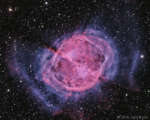 M27: The Dumbbell Nebula
1.11.2016
The first hint of what will become of our Sun was discovered inadvertently in 1764. At that time, Charles Messier was compiling a list of diffuse objects not to be confused with comets.
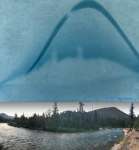 Solar Eclipse Solargraph
21.09.2017
Today is the September equinox. Heading south, the Sun's path through the sky will cross the celestial equator at 20:02 UT. Of course the equinox date results in (mostly) equal night and day all over planet Earth.
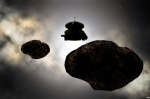 New Horizons at Ultima Thule
28.12.2018
When we celebrate the start of 2019, on January 1 the New Horizons spacecraft will flyby Ultima Thule. A world of the Kuiper belt 6.5 billion kilometers from the Sun, the nickname Ultima Thule (catalog designation 2014 MU69) fittingly means "beyond the known world".
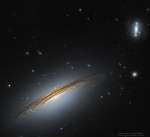 UGC 12591: The Fastest Rotating Galaxy Known
18.02.2020
Why does this galaxy spin so fast? To start, even identifying which type of galaxy UGC 12591 is difficult -- featured on the lower left, it has dark dust lanes like a spiral galaxy but a large diffuse bulge of stars like a lenticular.
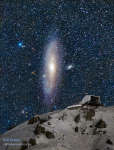 Andromeda Station
25.03.2020
This surreal picture isn't from a special effects sci-fi movie. It is a digital composite of frames of the real Andromeda Galaxy, also known as M31, rising over a real mountain. Exposures tracking the galaxy and background stars have been digitally combined with separate exposures of the foreground terrain.
 APOD: 2023 August 15 Б A Triply Glowing Night Sky over Iceland
14.08.2023
The Sun is not the quiet place it seems. It expels an unsteady stream of energetic electrons and protons known as the solar wind. These charged particles deform the Earth's magnetosphere, change paths...
|
January February March April May June July August September October |
|||||||||||||||||||||||||||||||||||||||||||||||||