
|
You entered: light
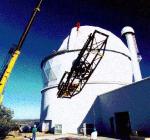 HET: The New Largest Optical Telescope
26.12.1996
Most of our universe is too dim to see. To peer into our cosmos' unknown depths, astronomers must deploy new tools - and the classic new tool is a larger telescope. Pictured above is the new Hobby-Eberly Telescope (HET) which recently declared "first light" in western Texas.
 M51: Cosmic Whirlpool
28.04.2005
Follow the handle of the Big Dipper away from the dipper's bowl, until you get to the handle's last bright star. Then, just slide your telescope a little south and west and you might find this stunning pair of interacting galaxies, the 51st entry in Charles Messier's famous catalog.
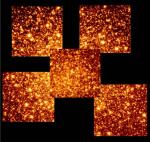 NGC 6712: Galactic Globular Cluster
24.02.1999
Following orbits which loop high above the galactic plane, globular star clusters are probably 12 to 14 billion years old - truly ancient denizens of our Milky Way Galaxy. After analyzing these new ESO/VLT images...
 The Universe Nearby
10.12.2007
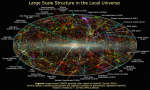
What does the universe nearby look like? This plot shows over one and a half million of the brightest stars and galaxies in the nearby universe detected by the Two Micron All Sky Survey (2MASS) in infrared light.
 Weak Lensing Distorts the Universe
29.03.2008
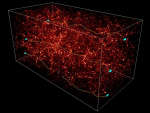
Is the distant universe really what it appears to be? Astronomers hope not. Intervening dark matter, which is normally invisible, might show its presence by distorting images originating in the distant universe, much the way an old window distorts images originating on the other side.
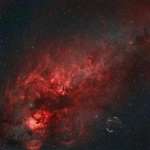 Nebulae in the Northern Cross
18.11.2010
Explore a beautiful and complex region of nebulae strewn along the plane of our Milky Way Galaxy in this widefield skyscape. The image emphasizes cosmic gas clouds in a 25 by 25 degree view centered on the Northern Cross, the famous asterism in the constellation Cygnus.
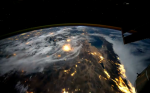 Flying over Planet Earth
27.09.2011
Have you ever dreamed of flying high above the Earth? Astronauts visiting the International Space Station do this every day, circling our restless planet twice every three hours. A dramatic example of their view was compiled in the above time-lapse video from images taken earlier this month.
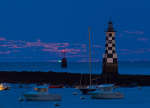 Green Flash and Super Moon
10.05.2012
It was really not about superheroes as on May 6 the much touted Super Moon, the largest Full Moon of 2012, rose over this otherwise peaceful harbor. And no supervillains were present either as boats gently rocked at their moorings near the checkerboard La Perdrix lighthouse on the coast of Brittany, France.
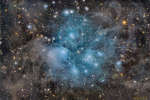 The Pleiades Deep and Dusty
25.02.2014
The well known Pleiades star cluster is slowly destroying part of a passing cloud of gas and dust. The Pleiades is the brightest open cluster of stars on Earth's sky and can be seen from almost any northerly location with the unaided eye.
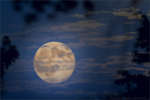 Surreal Moon
14.08.2014
Big, bright, and beautiful, a Full Moon near perigee, the closest point in its elliptical orbit around our fair planet, rose on August 10. This remarkable picture records the scene with a dreamlike quality from the east coast of the United States.
|
January February March April May June July August September October |
|||||||||||||||||||||||||||||||||||||||||||||||||