
|
You entered: Chandra
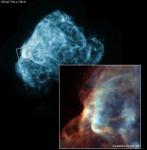 Supernova Remnant and Shock Wave
16.02.2006
A massive star ends life as a supernova, blasting its outer layers back to interstellar space. The spectacular death explosion is initiated by the collapse of what has become an impossibly dense stellar core. Pictured is the expanding supernova remnant Puppis A - one of the brightest sources in the x-ray sky.
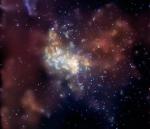 X Rays from the Galactic Core
7.01.2003
Using the orbiting Chandra X-ray Observatory, astronomers have taken this long look at the core of our Milky Way galaxy, some 26,000 light-years away. The spectacular false-color view spans about 130 light-years.
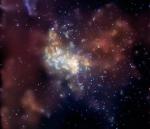 X-Rays from the Galactic Core
5.11.2004
Using the orbiting Chandra X-ray Observatory, astronomers have taken this long look at the core of our Milky Way galaxy, some 26,000 light-years away. The spectacular false-color view spans about 130 light-years.
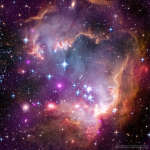 NGC 602 and Beyond
1.04.2017
Near the outskirts of the Small Magellanic Cloud, a satellite galaxy some 200 thousand light-years distant, lies 5 million year young star cluster NGC 602. Surrounded by natal gas and dust...
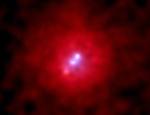 3C 295: X-rays From A Giant Galaxy
24.11.1999
Did this galaxy eat too much? Five billion light-years away, the giant elliptical galaxy 3C295 is a prodigious source of energy at radio wavelengths. Bright knots of X-ray emission are also seen at the center of this false-color Chandra Observatory image of the region.
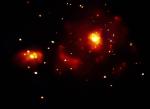 M51: X Rays from the Whirlpool
11.07.2002
Fresh from yesterday's episode, a popular pair of interacting galaxies known as the Whirlpool debut here beyond the realm of visible light -- imaged at high energies by the orbiting Chandra X-ray Observatory. Still turning in a remarkable performance, over 80 glitering x-ray stars are present in the Chandra image data from the region.
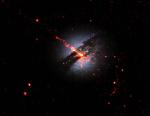 X Ray Jet From Centaurus A
28.10.1999
Spanning over 25,000 light-years, comparable to the distance from the Sun to the center of our own Milky Way galaxy, a cosmic jet seen in X-rays blasts from the center of Centaurus A. Only 10 million light-years away, Centaurus A is a giant elliptical galaxy - the closest active galaxy to Earth.
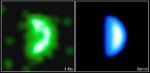 Venusian Half Shell
10.12.2001
Venus, second planet from the Sun, appears above imaged for the first time ever in x-rays (left) by the orbiting Chandra Observatory. Chandra's smoothed, false-color, x-ray view is compared to an optical image (right) from a small earthbound telescope.
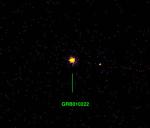 GRB010222: Gamma Ray Burst, X Ray Afterglow
13.04.2001
A fading afterglow from one of the most powerful explosions in the universe is centered in this false color image from the spacebased Chandra X-ray Observatory. The cosmic explosion, an enormously bright gamma-ray burst (GRB), originated in a galaxy billions of light-years away and was detected by the BeppoSAX satellite on February 22.
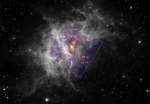 Young Star Cluster Westerlund 2
30.01.2008
Dusty stellar nursery RCW 49 surrounds young star cluster Westerlund 2 in this remarkable composite skyscape from beyond the visible spectrum of light. Infrared data from the Spitzer Space Telescope is shown in black...
|
January February March April May June July August September |
|||||||||||||||||||||||||||||||||||||||||||||||||