
|
You entered: Chandra
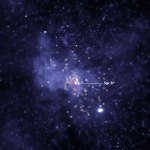 A Plurality of Singularities at the Galactic Center
11.05.2018
A recent informal poll found that astronomers don't yet have a good collective noun for a group of black holes, but they need one. The red circles in this Chandra Observatory X-ray image identify a group of a dozen black holes that are members of binary star systems.
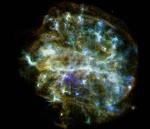 Elements in the Aftermath
26.10.2001
Massive stars spend their brief lives furiously burning nuclear fuel. Through fusion at extreme temperatures and densities surrounding the stellar core, nuclei of light elements like Hydrogen and Helium are combined to heavier elements like Carbon, Oxygen, etc. in a progression which ends with Iron.
 N132D and the Color of X Rays
23.05.2002
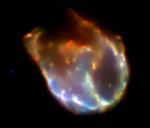
Supernova remnant N132D shows off complex structures in this sharp, color x-ray image. Still, overall this cosmic debris from a massive star's explosive death has a strikingly simple horseshoe shape. While N132D lies 180,000 light-years distant in the Large Magellanic Cloud, the expanding remnant appears here about 80 light-years across.
 Dark Matter, X rays, and NGC 720
26.10.2002
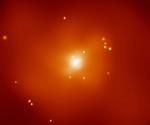
Elliptical galaxy NGC 720 is enveloped in a cosmic cloud of x-ray emitting gas. Seen in this false color image from the Chandra X-ray Observatory, the extreme temperature of the gas - about 7 million...
 Mira: The Wonderful Star
22.07.2006
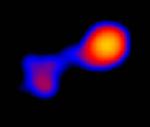
To seventeenth century astronomers, Omicron Ceti or Mira was known as a wonderful star - a star whose brightness could change dramatically in the course of about 11 months. Modern astronomers now recognize an entire class of long period Mira-type variables as cool, pulsating, red giant stars, 700 or so times the diameter of the Sun.
 NGC 2392: Double Shelled Planetary Nebula
15.02.2020
To some, this huge nebula resembles a person's head surrounded by a parka hood. In 1787, astronomer William Herschel discovered this unusual planetary nebula: NGC 2392. More recently, the Hubble Space Telescope imaged the nebula in visible light, while the nebula was also imaged in X-rays by the Chandra X-ray Observatory.
 APOD: 2024 July 2 Б NGC 602: Oyster Star Cluster
1.07.2024
The clouds may look like an oyster, and the stars like pearls, but look beyond. Near the outskirts of the Small Magellanic Cloud, a satellite galaxy some 200 thousand light-years distant, lies this 5 million year old star cluster NGC 602.
 X Ray Mystery in RCW 38
26.12.2002
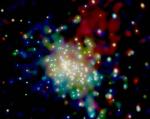
A mere 6,000 light-years distant and sailing through the constellation Vela, star cluster RCW 38 is full of powerful stars. It's no surprise that these stars, only a million years young with hot outer atmospheres, appear as point-like x-ray sources dotting this x-ray image from the orbiting Chandra Observatory.
 X Ray Mystery in RCW 38
7.01.2005
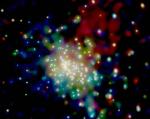
A mere 6,000 light-years distant and sailing through the constellation Vela, star cluster RCW 38 is full of powerful stars. It's no surprise that these stars, only a million years young with hot outer atmospheres, appear as point-like x-ray sources dotting this x-ray image from the orbiting Chandra Observatory.
 X Ray Milky Way
9.01.2002
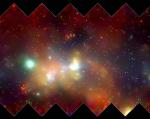
If you had x-ray vision, the center regions of our galaxy would not be hidden from view by immense cosmic dust clouds opaque to visible light. Instead, the Milky Way toward Sagittarius might look something like this stunning mosaic of images from the orbiting Chandra Observatory.
|
January February March April May June July August September |
|||||||||||||||||||||||||||||||||||||||||||||||||