
|
You entered: Chandra
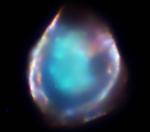 DEM L71: When Small Stars Explode
13.03.2003
Large, massive stars end their furious lives in spectacular supernova explosions -- but small, low mass stars may encounter a similar fate. In fact, instead of simply cooling off and quietly fading away, some white...
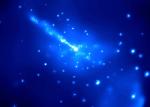 Centaurus A: X-Rays from an Active Galaxy
5.07.2003
Its core hidden from optical view by a thick lane of dust, the giant elliptical galaxy Centaurus A was among the first objects observed by the orbiting Chandra X-ray Observatory. Astronomers were not disappointed, as Centaurus A's appearance in x-rays makes its classification as an active galaxy easy to appreciate.
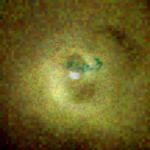 X-Rays From The Perseus Cluster Core
15.06.2000
The Perseus Cluster of thousands of galaxies, 320 million light-years distant, is one of the most massive objects in the Universe. At its core lies the giant cannibal galaxy Perseus A (NGC 1275), accreting matter as gas and galaxies fall into it.
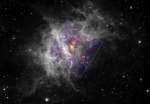 Young Star Cluster Westerlund 2
26.06.2010
Dusty stellar nursery RCW 49 surrounds young star cluster Westerlund 2 in this remarkable composite skyscape from beyond the visible spectrum of light. Infrared data from the Spitzer Space Telescope is shown in black...
 APOD: 2024 January 7 Б The Cats Eye Nebula in Optical and X-ray
6.01.2024
To some it looks like a cat's eye. To others, perhaps like a giant cosmic conch shell. It is actually one of the brightest and most highly detailed planetary nebula known, composed of gas expelled in the brief yet glorious phase near the end of life of a Sun-like star.
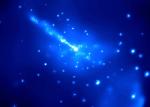 Centaurus A: X Rays from an Active Galaxy
16.08.2001
Its core hidden from optical view by a thick lane of dust, the giant elliptical galaxy Centaurus A was among the first objects observed by the orbiting Chandra X-ray Observatory. Astronomers were not disappointed, as Centaurus A's appearance in x-rays makes its classification as an active galaxy easy to appreciate.
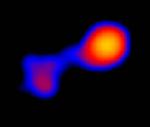 Mira: The Wonderful Star
5.05.2005
To seventeenth century astronomers, Omicron Ceti or Mira was known as a wonderful star - a star whose brightness could change dramatically in the course of about 11 months. Modern astronomers now recognize an entire class of long period Mira-type variables as cool, pulsating, red giant stars, 700 or so times the diameter of the Sun.
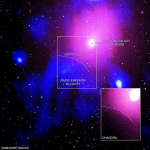 An Extreme Black Hole Outburst
10.03.2020
Astronomers believe they have now found the most powerful example of a black hole outburst yet seen in our Universe. The composite, false-color featured image is of a cluster of galaxies in the constellation of Ophiuchus, the serpent-bearer.
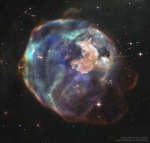 N63A: Supernova Remnant in Visible and X-ray
10.12.2019
What has this supernova left behind? As little as 2,000 years ago, light from a massive stellar explosion in the Large Magellanic Cloud (LMC) first reached planet Earth. The LMC is a close...
 APOD: 2024 April 3 Б Unusual Nebula Pa 30
2.04.2024
What created this unusual celestial firework? The nebula, dubbed Pa 30, appears in the same sky direction now as a bright "guest star" did in the year 1181. Although Pa 30's filaments look...
|
January February March April May June July August September |
|||||||||||||||||||||||||||||||||||||||||||||||||