
|
You entered: background
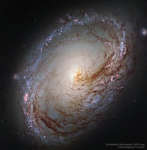 Spiral Galaxy M96 from Hubble
21.09.2015
Dust lanes seem to swirl around the core of Messier 96 in this colorful, detailed portrait of the center of a beautiful island universe. Of course M96 is a spiral galaxy, and counting...
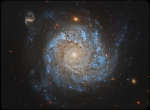 NGC 1309: Spiral Galaxy and Friends
14.07.2016
A gorgeous spiral galaxy some 100 million light-years distant, NGC 1309 lies on the banks of the constellation of the River (Eridanus). NGC 1309 spans about 30,000 light-years, making it about one third the size of our larger Milky Way galaxy.
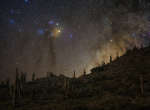 Deepscape at Yacoraite
8.05.2021
In this evocative night scene a dusty central Milky Way rises over the ancient Andean archaeological site of Yacoraite in northwestern Argentina. The denizens of planet Earth reaching skyward are the large Argentine saguaro cactus currently native to the arid region.
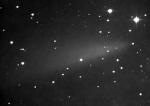 Comet LINEAR: Fade To Black
13.09.2000
Only last month the stage was set for Comet LINEAR (C/1999S4 LINEAR) to become the first "naked-eye" comet of Y2K. It didn't fill that role, of course, but it did turn in a very dramatic performance.
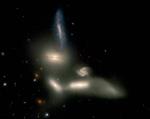 Seyfert's Sextet
24.01.2003
Known as Seyfert's Sextet, this intriguing group of galaxies lies in the head portion of the split constellation Serpens. The sextet actually contains only four interacting galaxies, though. Near the center of this...
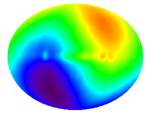 CMBR Dipole: Speeding Through the Universe
9.03.2008
Our Earth is not at rest. The Earth moves around the Sun. The Sun orbits the center of the Milky Way Galaxy. The Milky Way Galaxy orbits in the Local Group of Galaxies. The Local Group falls toward the Virgo Cluster of Galaxies.
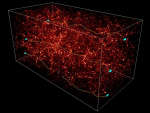 Weak Lensing Distorts the Universe
30.03.2008
Is the distant universe really what it appears to be? Astronomers hope not. Intervening dark matter, which is normally invisible, might show its presence by distorting images originating in the distant universe, much the way an old window distorts images originating on the other side.
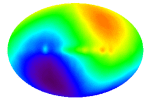 CMBR Dipole: Speeding Through the Universe
6.09.2009
Our Earth is not at rest. The Earth moves around the Sun. The Sun orbits the center of the Milky Way Galaxy. The Milky Way Galaxy orbits in the Local Group of Galaxies. The Local Group falls toward the Virgo Cluster of Galaxies.
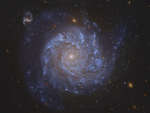 NGC 1309: Spiral Galaxy and Friends
16.01.2013
A gorgeous spiral galaxy some 100 million light-years distant, NGC 1309 lies on the banks of the constellation of the River (Eridanus). NGC 1309 spans about 30,000 light-years, making it about one third the size of our larger Milky Way galaxy.
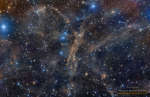 A Dust Angel Nebula
28.04.2016
The combined light of stars along the Milky Way are reflected by these cosmic dust clouds that soar some 300 light-years or so above the plane of our galaxy. Dubbed the Angel Nebula, the faint apparition is part of an expansive complex of dim and relatively unexplored, diffuse molecular clouds.
|
January February March April May June July August September |
|||||||||||||||||||||||||||||||||||||||||||||||||