
|
You entered: background
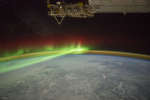 Aurora and Manicouagan Crater from the Space Station
28.05.2018
How many of these can you find in today's featured photograph: an aurora, airglow, one of the oldest impact craters on the Earth, snow and ice, stars, city lights, and part of the International Space Station? Most of these can be identified by their distinctive colors.
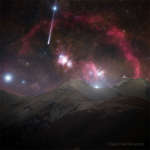 APOD: 2026 May 15 Б R3 PanSTARRS: An Orion Comet
14.05.2026
Comet R3 PanSTARRS might be best remembered as an Orion comet. A key reason is because Comet C/2025 R3 (PanSTARRS) was near its most spectacular -- in terms of tail visibility -- when passing in front of the iconic constellation.
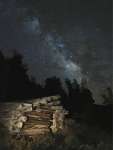 Lyrid Meteor and Milky Way
1.05.2009
On April 22nd, the Lyrid Meteor Shower visited planet Earth's sky, an annual shower produced as the Earth plows through dust from the tail of comet Thatcher. Usually Lyrid meteor watchers see only a drizzle.
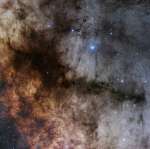 The Pipe Nebula
23.11.2012
East of Antares, dark markings sprawl through crowded star fields toward the center of our Milky Way Galaxy. Cataloged in the early 20th century by astronomer E. E. Barnard, the obscuring interstellar dust clouds include B59, B72, B77 and B78, seen in silhouette against the starry background.
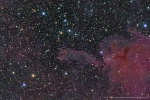 Cometary Globule CG4
5.03.2015
The faint and somehow menacing cometary globule CG4 reaches through the center of this deep southern skyscape. About 1,300 light-years from Earth toward the constellation Puppis, its head is about 1.5 light-years in diameter and its tail about 8 light-years long.
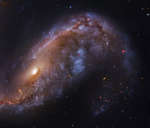 NGC 2442: Galaxy in Volans
16.08.2017
Distorted galaxy NGC 2442 can be found in the southern constellation of the flying fish, (Piscis) Volans. Located about 50 million light-years away, the galaxy's two spiral arms extending from a pronounced central bar have a hook-like appearance in wide-field images.
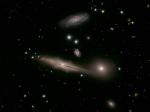 Galaxy Group HCG 87
31.07.2003
Posing for this cosmic family photo are the galaxies of HCG (Hickson Compact Group) 87, about four hundred million light-years distant toward the amphibious constellation Capricornus. The large edge-on spiral near picture center...
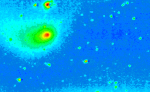 Comet Hale-Bopp Outbound
10.09.1997
Hale-Bopp, the Comet of the Century, is leaving the inner Solar System. Outbound at about 12 miles per second it is presently nearing the main asteroid belt between Mars and Jupiter. This false-color image represents a recent view from low Earth orbit showing the comet surrounded by its shrinking coma against a background of stars.
 Z is for Mars
22.04.2006
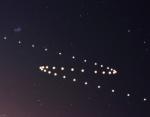
This composite of images spaced about a week apart - from late July 2005 (bottom right) through February 2006 (top left) - traces the retrograde motion of ruddy-colored Mars through planet Earth's night sky. On November 7th, 2005 the Red Planet was opposite the Sun in Earth's sky (at opposition).
 Abell 2744: Pandoras Cluster of Galaxies
29.06.2011
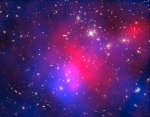
Why is this cluster of galaxies so jumbled? Far from a smooth distribution, Abell 2744 not only has knots of galaxies, but the X-ray emitting hot gas (colored red) in the cluster appears distributed differently than the dark matter.
|
January February March April May June July August September |
|||||||||||||||||||||||||||||||||||||||||||||||||