
|
You entered: Orion
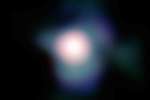 Betelgeuse Resolved
5.08.2009
The sharpest image ever of Betelgeuse shows a mammoth star that is slowly evaporating. Betelgeuse (sounds a lot like "beetle juice"), also known as Alpha Orionis, is one of the largest and brightest stars known. The star is a familiar orange fixture easily visible to the unaided eye toward the constellation of Orion.
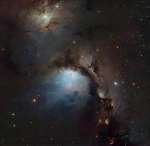 Hidden Treasures of M78
27.01.2011
M78 isn't really hiding in planet Earth's night sky. About 1,600 light-years away and nestled in the nebula rich constellation Orion, the large, bright, reflection nebula is well-known to telescopic skygazers. But this gorgeous image of M78 was selected as the winner of the Hidden Treasures 2010 astrophotography competition.
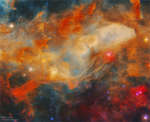 The Blue Horsehead Nebula in Infrared
23.04.2018
The Blue Horsehead Nebula looks quite different in infrared light. In visible light, the reflecting dust of the nebula appears blue and shaped like a horse's head. In infrared light, however, a complex labyrinth of filaments, caverns, and cocoons of glowing dust and gas emerges, making it hard to even identify the equine icon.
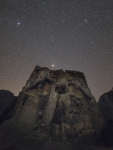 Mars, Pleiades, and Andromeda over Stone Lions
13.10.2020
Three very different -- and very famous -- objects were all captured in a single frame last month. On the upper left is the bright blue Pleiades, perhaps the most famous cluster of stars on the night sky. The Pleiades (M45) is about 450 light years away and easily found a few degrees from Orion.
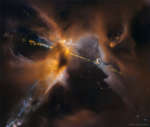 Duel Particle Beams in Herbig Haro 24
11.03.2018
This might look like a double-bladed lightsaber, but these two cosmic jets actually beam outward from a newborn star in a galaxy near you. Constructed from Hubble Space Telescope image data, the stunning scene...
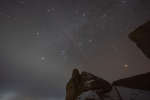 Trail of the Returner
31.12.2020
Familiar stars of a northern winter's night shine in this night skyview, taken near Zhangye, Gansu, China and the border with Inner Mongolia. During the early hours of December 17 Orion is near...
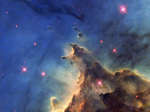 NGC 2174: Stars Versus Mountains
9.02.2011
It's stars versus gas mountains in NGC 2174 and the stars are winning. More precisely, the energetic light and winds from massive newly formed stars are evaporating and dispersing the dark stellar nurseries in which they formed.
 Planet Building in HD 100546
2.05.2001
More than 100 billion boulders may be swarming in the disk around nearby star HD 100546. In a scene thought similar to the early years of our own Solar System, ever larger rocks are growing by colliding and accreting dust as the messy business of planet formation appears to be underway.
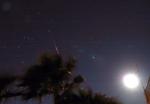 Leonids vs The Moon
20.11.2002
Beautiful and bright, the 2002 Leonid meteors battled against glaring moonlight. This winning example, from Tuesday morning skies above Laughlin, Nevada, USA, finds an undaunted Leonid streaking between the familiar constellation of Orion (left) and an overexposed full Moon.
 Southern Ocean Sky
4.07.2011
Clouds and sky both show illuminating changes during this time lapse video from the south of Australia. In the foreground are scenes visible over a rocky coastline toward the Southern Ocean. Dark clouds flow...
|
January February March April May June July August September |
|||||||||||||||||||||||||||||||||||||||||||||||||