
|
You entered: Orion
 JWST on the Road to L2
31.12.2021
This timelapse gif tracks the James Webb Space Telescope as it streaks across the stars of Orion on its journey to a destination beyond the Moon. Recorded on December 28, 12 consecutive exposures each 10 minutes long were aligned and combined with a subsequent color image of the background stars to create the animation.
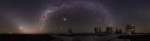 Wonder and Mystery above the Very Large Telescopes
9.05.2011
What's that bright orange dot above the large telescope on the right? Even seasoned sky enthusiasts might ponder the origin of the orange orb seen by scrolling across this panoramic image, taken last December. Perhaps identifying known objects will help.
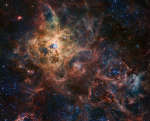 The Tarantula Nebula
26.02.2016
The Tarantula Nebula is more than a thousand light-years in diameter, a giant star forming region within nearby satellite galaxy the Large Magellanic Cloud, about 180 thousand light-years away. The largest, most violent star...
 Stars and Dust across Corona Australis
22.06.2023
Cosmic dust clouds cross a rich field of stars in this telescopic vista near the northern boundary of Corona Australis, the Southern Crown. Part of a sprawling molecular cloud complex this star forming region is a mere 500 light-years away.
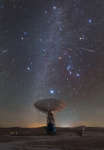 Geminids of the North
15.12.2017
Earth's annual Geminid meteor shower did not disappoint as our fair planet plowed through dust from active asteroid 3200 Phaethon. Captured in this northern hemisphere nightscape, the meteors stream away from the shower's radiant in Gemini.
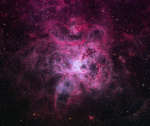 The Tarantula Nebula
17.11.2018
The Tarantula Nebula, also known as 30 Doradus, is more than a thousand light-years in diameter, a giant star forming region within nearby satellite galaxy the Large Magellanic Cloud. About 180 thousand light-years away, it's the largest, most violent star forming region known in the whole Local Group of galaxies.
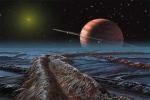 Other Worlds and HD 38529
10.08.2000
After the latest round of discovery announcements, the list of known worlds of distant suns has grown to 50. While extrasolar planet discoveries are sure to continue, none - so far - points clearly to another planetary system like our own. Take, for example, the newly discovered parent star HD38529.
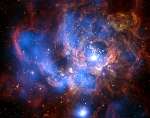 NGC 604: X rays from a Giant Stellar Nursery
5.02.2009
Some 3 million light-years distant in nearby spiral galaxy M33, giant stellar nursery NGC 604 is about 1,300 light-years across, or nearly 100 times the size of the Orion Nebula. In fact, among...
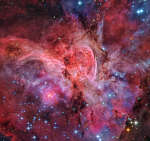 Carina Nebula Close Up
15.02.2020
A jewel of the southern sky, the Great Carina Nebula, also known as NGC 3372, spans over 300 light-years, one of our galaxy's largest star forming regions. Like the smaller, more northerly Great...
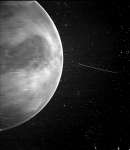 A Venus Flyby
25.02.2021
On a mission to explore the inner heliosphere and solar corona, on July 11, 2020 the Wide-field Imager on board NASA's Parker Solar Probe captured this stunning view of the nightside of Venus at distance of about 12,400 kilometers (7,693 miles).
|
January February March April May June July August September |
|||||||||||||||||||||||||||||||||||||||||||||||||