
|
You entered: Orion
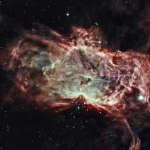 Inside the Flame Nebula
17.04.2021
The Flame Nebula is a stand out in optical images of the dusty, crowded star forming regions toward Orion's belt and the easternmost belt star Alnitak, a mere 1,400 light-years away. Alnitak is the bright star at the right edge of this infrared image from the Spitzer Space Telescope.
 APOD: 2024 February 25 Б A Phoenix Aurora over Iceland
25.02.2024
All of the other aurora watchers had gone home. By 3:30 am in Iceland, on a quiet September night, much of that night's auroras had died down. Suddenly, unexpectedly, a new burst of particles streamed down from space, lighting up the Earth's atmosphere once again.
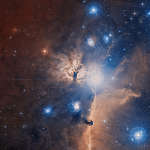 Inside the Flame Nebula
10.05.2014
The Flame Nebula stands out in this optical image of the dusty, crowded star forming regions toward Orion's belt, a mere 1,400 light-years away. X-ray data from the Chandra Observatory and infrared images from the Spitzer Space Telescope can take you inside the glowing gas and obscuring dust clouds though.
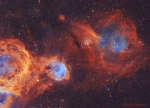 Carina Nebula North
31.01.2022
The Great Carina Nebula is home to strange stars and iconic nebulas. Named for its home constellation, the huge star-forming region is larger and brighter than the Great Orion Nebula but less well known because it is so far south -- and because so much of humanity lives so far north.
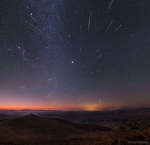 Geminid Meteors over Chile
8.12.2019
Are meteors streaming out from a point in the sky? Yes, in a way. When the Earth crosses a stream of Sun-orbiting meteors, these meteors appear to come from the direction of the stream -- with the directional point called the radiant.
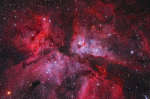 The Great Carina Nebula
15.10.2013
A jewel of the southern sky, the Great Carina Nebula, also known as NGC 3372, spans over 300 light-years, one of our galaxy's largest star forming regions. Like the smaller, more northerly Great...
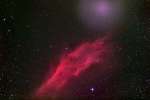 Comet over California
7.03.2008
Still gracing northern skies, a fading Comet Holmes lies at the top edge of this colorful skyview, recorded on March 4. The reddish emission nebula below it is NGC 1499, also known as the California Nebula for its resemblance to the outline of the state on the US west coast.
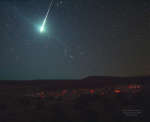 Bright Bolide
11.10.2008
On September 30, a spectacular bolide or fireball meteor surprised a group of amateur astronomers enjoying dark night skies over the Oklahoma panhandle's Black Mesa State Park in the Midwestern US. Flashing past...
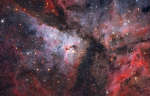 The Great Carina Nebula
27.12.2018
A jewel of the southern sky, the Great Carina Nebula, also known as NGC 3372, spans over 300 light-years, one of our galaxy's largest star forming regions. Like the smaller, more northerly Great...
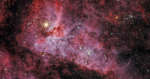 The Great Carina Nebula
27.05.2016
A jewel of the southern sky, the Great Carina Nebula, also known as NGC 3372, spans over 300 light-years, one of our galaxy's largest star forming regions. Like the smaller, more northerly Great...
|
January February March April May June July August September |
|||||||||||||||||||||||||||||||||||||||||||||||||