
|
You entered: satellite
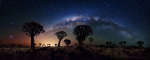 Milky Way Over Quiver Tree Forest
12.12.2012
In front of a famous background of stars and galaxies lies some of Earth's more unusual trees. Known as quiver trees, they are actually succulent aloe plants that can grow to tree-like proportions. The quiver tree name is derived from the historical usefulness of their hollowed branches as dart holders.
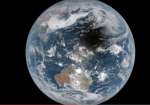 Moon Shadow versus Sun Reflection
17.07.2017
What are those lights and shadows crossing the Earth? As the featured five-second time-lapse video progresses, a full day on planet Earth is depicted as seen from Japan's Himawari-8 satellite in geostationary orbit high above the Pacific Ocean.
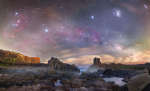 From Orion to the Southern Cross
18.01.2022
This is a sky filled with glowing icons. On the far left is the familiar constellation of Orion, divided by its iconic three-aligned belt stars and featuring the famous Orion Nebula, both partly encircled by Barnard's Loop. Just left of center in the featured image is the brightest star in the night: Sirius.
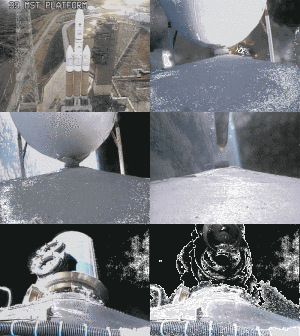 First Launch of the Delta IV Heavy
26.01.2005
The new Delta IV Heavy Launch Vehicle is the largest rocket ever to be launched by the US Air Force. The Delta IV Heavy is capable of launching over 23,000 kilograms into low Earth orbit.
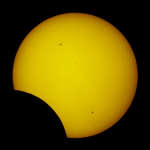 Eclipsing the Sun
5.01.2011
Skywatchers throughout much of Europe, North Africa, and Central Asia, were treated to the first eclipse of the new year on January 4, a partial eclipse of the Sun. But traveling to the area...
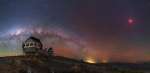 Eclipsed in Southern Skies
1.10.2015
This stunning panorama in southern skies was recorded on the colorful night of September 27/28 from Carngegie Las Campanas Observatory. A diffuse glow and dark rifts of the central Milky Way hang over domes of the twin 6.5 meter Magellan telescopes. But most eye-catching is the deep red glow of the Moon.
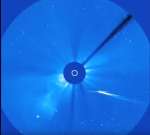 Comet ISON Being Destroyed by the Sun
2.11.2015
Most comets don't survive a close encounter with the Sun. Two years ago this month, though, Comet ISON was thought by some to be big enough to withstand its perilous sungrazing dive. The featured video shows the drama as it was recorded by NASA's Solar and Heliospheric Observatory (SOHO) satellite.
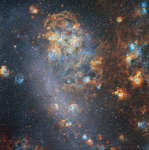 Shell Game in the LMC
29.12.2016
An alluring sight in southern skies, the Large Magellanic Cloud (LMC) is seen here through narrowband filters. The filters are designed to transmit only light emitted by ionized sulfur, hydrogen, and oxygen atoms. Ionized...
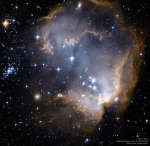 NGC 602 and Beyond
16.05.2021
The clouds may look like an oyster, and the stars like pearls, but look beyond. Near the outskirts of the Small Magellanic Cloud, a satellite galaxy some 200 thousand light-years distant, lies 5 million year young star cluster NGC 602.
 APOD: 2024 October 29 Б NGC 602: Stars Versus Pillars from Webb
29.10.2024
The stars are destroying the pillars. More specifically, some of the newly formed stars in the image center are emitting light so energetic that is evaporating the gas and dust in the surrounding pillars. Simultaneously, the pillars themselves are still trying to form new stars.
|
January February March April May June July August |
||||||||||||||||||||||||||||||||||||||||||||||||||||||||