
|
You entered: satellite
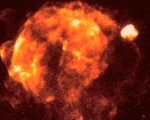 Vela Supernova Remnant in X-ray
12.06.1996
What happens when a star explodes? A huge fireball of hot gas shoots out in all directions. When this gas slams into the existing interstellar medium, it heats up so much it glows in X-rays.
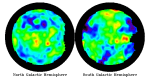 COBE Hotspots:The Oldest Structures Known
8.03.1997
Above are two images of the microwave sky, north and south of our galaxy's equator, based on data from NASA's COsmic Background Explorer (COBE) satellite. After computer processing to remove contributions from nearby objects and the effects of the earth's motion, they show "spots".
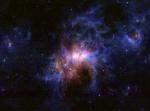 Dusty Environs of Eta Carinae
15.10.2005
Eta Car is a massive star, but it's not as bright as it used to be. Now only easily visible in binoculars or a small telescope, Eta Carinae has a history of spectacular flaring and fading behavior.
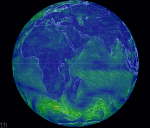 The Winds of Earth
9.10.2016
Which way is the wind blowing? The featured map can tell you this and much more, no matter your location on planet Earth. The dynamic map displays supercomputer forecasts drawn from multiple sources of global satellite data updated every three hours.
 APOD: 2024 October 13 Б Aurora Timelapse Over Italian Alps
12.10.2024
Did you see last night's aurora? This question was relevant around much of the world a few days ago because a powerful auroral storm became visible unusually far from the Earth's poles.
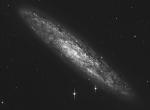 Spiral Galaxy NGC 253
20.01.1999
A camera with over 67 million pixels (digital picture elements) was used to record this stunning image of spiral galaxy NGC 253. Known as the Wide Field Imager (WFI), the camera is the latest instrument to be installed at the European Southern Observatory's 2.2 meter telescope in La Silla, Chile.
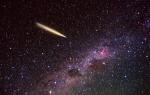 Mystery Over Australia
21.02.2007
Place your cursor on this stunning view of dark skies over western Australia to highlight wonders of the southern Milky Way -- including the famous Southern Cross, the dark Coal Sack Nebula, and bright reddish emission regions surrounding massive star Eta Carinae.
 Earth Rotating Under Very Large Telescopes
1.06.2011
Why is the Earth moving in the above video? Most time lapse videos of the night sky show the stars and sky moving above a steady Earth. Here, however, the frames have been digitally rotated so that it is the stars that stay (approximately) steady, and the Earth that moves beneath them.
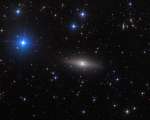 NGC 7814: The Little Sombrero in Pegasus
25.10.2013
Point your telescope toward the high flying constellation Pegasus and you can find this expanse of Milky Way stars and distant galaxies. Centered on NGC 7814, the pretty field of view would almost be covered by a full moon.
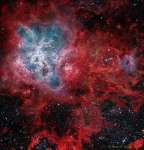 The Cosmic Web of the Tarantula Nebula
7.11.2016
It is the largest and most complex star forming region in the entire galactic neighborhood. Located in the Large Magellanic Cloud, a small satellite galaxy orbiting our Milky Way galaxy, the region's spidery appearance is responsible for its popular name, the Tarantula nebula. This tarantula, however, is about 1,000 light-years across.
|
January February March April May June July August |
||||||||||||||||||||||||||||||||||||||||||||||||||||||||