
|
You entered: satellite
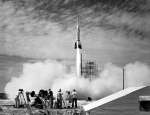 The First Rocket Launch from Cape Canaveral
19.07.2015
A new chapter in space flight began this week in 1950 July with the launch of the first rocket from Cape Canaveral, Florida: the Bumper V-2. Shown above, the Bumper V-2 was an ambitious two-stage rocket program that topped a V-2 missile base with a WAC Corporal rocket.
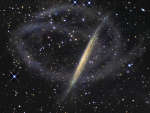 The Star Streams of NGC 5907
16.11.2019
Grand tidal streams of stars seem to surround galaxy NGC 5907. The arcing structures form tenuous loops extending more than 150,000 light-years from the narrow, edge-on spiral, also known as the Splinter or Knife Edge Galaxy.
 APOD: 2025 August 25 Б The Meteor and the Star Cluster
25.08.2025
Sometimes even the sky surprises you. To see more stars and faint nebulosity in the Pleiades star cluster (M45), long exposures are made. Many times, less interesting items appear on the exposures that were not intended -- but later edited out.
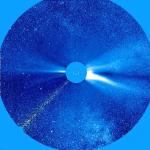 Solar Wind And Milky Way
4.03.1997
The Sun is bright, so bright that it overwhelms the light from other stars even for most satellite-borne telescopes. But LASCO, a coronograph onboard the space-based SOHO Observatory, uses occulting disks to block the intense solar light and examine the tenuous, hot gases millions of miles above the Sun's surface.
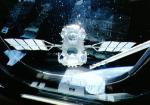 Boosting Compton
6.06.1997
Even great observatories need a boost from time to time -- including the orbiting Compton Gamma-Ray Observatory. Sparkling reflections and the bright limb of the Earth are visible in this 1991 window view of Compton's release into orbit by the crew of the Space Shuttle Atlantis.
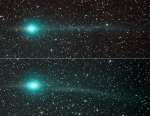 Comet Lulin Tails
7.02.2009
Sweeping through the inner solar system, Comet Lulin is easily visible in both northern and southern hemispheres with binoculars or a small telescope. Recent changes in Lulin's lovely greenish coma and tails are featured in this two panel comparison of images taken on January 31st (top) and February 4th.
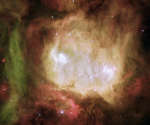 Halloween and the Ghost Head Nebula
31.10.2010
Halloween's origin is ancient and astronomical. Since the fifth century BC, Halloween has been celebrated as a cross-quarter day, a day halfway between an equinox (equal day / equal night) and a solstice (minimum day / maximum night in the northern hemisphere). With a modern calendar, however, the real cross-quarter day will occur next week.
 M33: Triangulum Galaxy
17.09.2016
The small, northern constellation Triangulum harbors this magnificent face-on spiral galaxy, M33. Its popular names include the Pinwheel Galaxy or just the Triangulum Galaxy. M33 is over 50,000 light-years in diameter, third largest in the Local Group of galaxies after the Andromeda Galaxy (M31), and our own Milky Way.
 APOD: 2024 January 24 Б Earth and Moon from Beyond
24.01.2024
What do the Earth and Moon look like from beyond the Moon? Although frequently photographed together, the familiar duo was captured with this unusual perspective in late 2022 by the robotic Orion spacecraft of NASA's Artemis I mission as it looped around Earth's most massive satellite and looked back toward its home world.
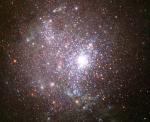 The Stars of NGC 1705
23.04.2003
Some 2,000 light-years across, NGC 1705 is small as galaxies go, similar to our Milky Way's own satellite galaxies, the Magellanic Clouds. At a much larger distance of 17 million light-years...
|
January February March April May June July August |
||||||||||||||||||||||||||||||||||||||||||||||||||||||||