
|
You entered: satellite
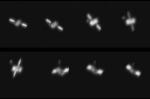 Compton Returns
6.03.2001
On 2000 June 4, the 17-ton Compton Gamma-Ray Observatory returned to Earth after 9 years in orbit -- ending its remarkable voyage of discovery. The massive, bus-sized spacecraft carried an unprecedented array of gamma-ray detectors which explored the bizarre, high-energy universe of solar flares, black holes, pulsars, supernovae, active galaxies, and gamma-ray bursts.
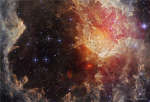 Stars and Dust Pillars in NGC 7822 from WISE
30.11.2014
Hot, young stars and cosmic pillars of gas and dust seem to crowd into NGC 7822. At the edge of a giant molecular cloud toward the northern constellation Cepheus, this glowing star forming region lies about 3,000 light-years away.
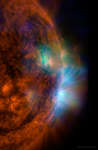 The Sun in X rays from NuSTAR
22.11.2021
Why are the regions above sunspots so hot? Sunspots themselves are a bit cooler than the surrounding solar surface because the magnetic fields that create them reduce convective heating. It is therefore unusual that regions overhead -- even much higher up in the Sun's corona -- can be hundreds of times hotter.
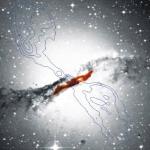 Centaurus A: The Galaxy Deep Inside
3.12.1998
Deep inside Centaurus A, the closest active galaxy to Earth, lies ... another galaxy! Cen A is a giant elliptical galaxy a mere 10 million light-years distant with a central jumble of stars, dust, and gas that probably hides a massive black hole.
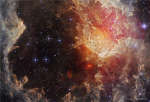 NGC 7822: Stars and Dust Pillars in Infrared
18.11.2017
Young stars themselves are clearing out their nursery in NGC 7822. Within the nebula, bright edges and complex dust sculptures dominate this detailed skyscape taken in infrared light by NASA's Wide Field Infrared Survey Explorer (WISE) satellite.
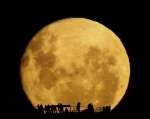 Full Moon Silhouettes
9.10.2021
Have you ever watched the Moon rise? The slow rise of a nearly full moon over a clear horizon can be an impressive sight. One impressive moonrise was imaged in early 2013 over Mount Victoria Lookout in Wellington, New Zealand.
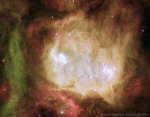 Halloween and the Ghost Head Nebula
23.10.2021
Halloween's origin is ancient and astronomical. Since the fifth century BC, Halloween has been celebrated as a cross-quarter day, a day halfway between an equinox (equal day / equal night) and a solstice (minimum day / maximum night in the northern hemisphere).
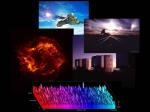 A Year of New Perspectives
27.12.1999
Fittingly, 1999 saw a decade of astronomical discoveries to an end with portents of things to come - embodied in new spacecraft, telescopes, and perspectives to explore the distant Universe across the electromagnetic spectrum. X-ray astronomy in particular will likely flourish in coming
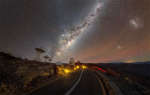 A Road to the Stars
14.03.2022
Pictured -- a very scenic road to the stars. The road approaches La Silla Observatory in Chile, with the ESO's 3.6-meter telescope just up ahead. To the left are some futuristic-looking support structures...
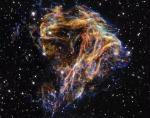 N49 s Cosmic Blast
4.07.2003
Scattered debris from a cosmic supernova explosion lights up the sky in this gorgeous composited image based on data from the Hubble Space Telescope. Cataloged as N49, these glowing filaments of shocked gas span about 30 light-years in our neighboring galaxy, the Large Magellanic Cloud.
|
January February March April May June July August |
||||||||||||||||||||||||||||||||||||||||||||||||||||||||