
|
You entered: satellite
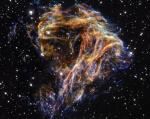 N49's Cosmic Blast
6.03.2004
Scattered debris from a cosmic supernova explosion lights up the sky in this gorgeous composited image based on data from the Hubble Space Telescope. Cataloged as N49, these glowing filaments of shocked gas span about 30 light-years in our neighboring galaxy, the Large Magellanic Cloud.
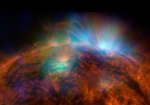 The Sun in X rays from NuSTAR
28.12.2014
Why are the regions above sunspots so hot? Sunspots themselves are a bit cooler than the surrounding solar surface because the magnetic fields that create them reduce convective heating. It is therefore unusual that regions overhead -- even much higher up in the Sun's corona -- can be hundreds of times hotter.
 APOD: 2024 October 2 Б The Large Magellanic Cloud Galaxy
2.10.2024
It is the largest satellite galaxy of our home Milky Way Galaxy. If you live in the south, the Large Magellanic Cloud (LMC) is quite noticeable, spanning about 10 degrees across the night sky, which is 20 times larger than the full moon towards the southern constellation of the dolphinfish (Dorado).
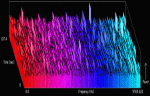 How to Search for Aliens
17.05.1999
"Mom, can I use our computer to search for aliens?" Last week, the SETI@home project released free software that enables many home computers to search for signals from intelligent extra-terrestrials. These signals may have already been detected by the huge Arecibo radio telescope
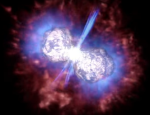 Eta Car: 3D Model of the Most Dangerous Star Known
9.02.2022
What's the most dangerous star near earth? Many believe it's Eta Carinae, a binary star system about 100 times the mass of the Sun, just 10,000 light years from earth.
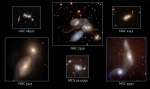 Black Holes in Merging Galaxies
29.05.2010
Violent galaxy mergers can feed supermassive black holes. Theoretically, the result is intense emission from regions near the supermassive black holes, creating the some of the most luminous objects in the universe. Astronomers dub these Active Galactic Nuclei, or just AGN.
 Earths Shrinking Antarctic Ice Sheet
8.03.2006
Is the continent at the end of the Earth slowly melting? For millions of years, Antarctica, the frozen continent at the southern end of planet Earth, has been encased in a gigantic sheet of ice. Recently, the orbiting robotic GRACE satellite has been taking sensitive measurements of the gravity for the entire Earth, including Antarctica.
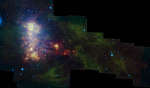 The Tail of the Small Magellanic Cloud
7.01.2010
A satellite galaxy of our Milky Way, the Small Magellanic Cloud is wonder of the southern sky, named for 16th century Portuguese circumnavigator Ferdinand Magellan. Some 200,000 light-years distant in the constellation Tucana...
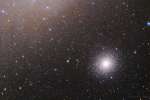 47 Tuc Near the Small Magellanic Cloud
6.12.2012
Globular star cluster 47 Tucanae is a jewel of the southern sky. Also known as NGC 104, it roams the halo of our Milky Way Galaxy along with around 200 other globular star clusters.
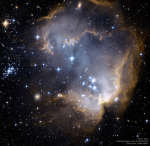 APOD: 2026 April 13 Б NGC 602 and Beyond
13.04.2026
The clouds may look like an oyster, and the stars like pearls, but look beyond. Near the outskirts of the Small Magellanic Cloud, a satellite galaxy some 200 thousand light-years distant, lies 5 million year young star cluster NGC 602.
|
January February March April May June July August |
||||||||||||||||||||||||||||||||||||||||||||||||||||||||