
|
You entered: satellite
 Interplanetary Earth
23.11.2024
In an interplanetary first, on July 19, 2013 Earth was photographed on the same day from two other worlds of the Solar System, innermost planet Mercury and ringed gas giant Saturn. Pictured...
 Universe Age from the Microwave Background
17.02.2003
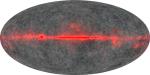
The above sky map tells us the universe is 13.7 billion years old -- but how? At first look, one only sees the microwave glow of gas from our Milky Way Galaxy, coded red, and a spotty pattern of microwaves emitted from the early universe, coded in gray.
 An Active Night over the Magellan Telescopes
21.02.2017
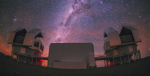
The night sky is always changing. Featured here are changes that occurred over a six hour period in late 2014 June behind the dual 6.5-meter Magellan Telescopes at Las Campanas Observatory in Chile.
 Clouds in the LMC
19.01.2018
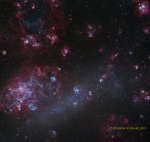
An alluring sight in southern skies, the Large Magellanic Cloud (LMC) is seen in this deep and detailed telescopic mosaic. Recorded with broadband and narrowband filters, the scene spans some 5 degrees or 10 full moons. The narrowband filters are designed to transmit only light emitted by hydrogen, and oxygen atoms.
 Interplanetary Earth
12.10.2019
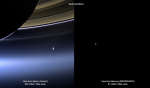
In an interplanetary first, on July 19, 2013 Earth was photographed on the same day from two other worlds of the Solar System, innermost planet Mercury and ringed gas giant Saturn. Pictured...
 A High Energy Fleet
25.05.1997
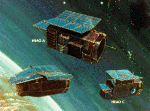
Looking like a fleet of futuristic starcruisers, NASA's highly successful series of High Energy Astrophysical Observatory (HEAO) spacecraft appear poised over planet Earth. Labeled A, B, and C in this vintage illustration, the spacebased telescopes were known as HEAO-1, HEAO-2, and HEAO-3 respectively.
 An Aurora Before the Storm
19.05.2000
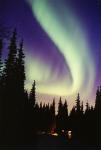
Early April brought some of the most intense auroral storms this decade. An aurora on April 6 was reported to be the largest visible on Earth since 1989, and was seen throughout Europe and much of northern North America.
 A Year of Resolving Cosmology
31.12.2003
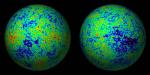
This year, humanity learned that the universe is 13.7 billion years old. Before this year, the universe's age was thought to be about 13 billion years, but really only constrained to be between about 12 billion and 15 billion years old.
 Equinox on a Spinning Earth
19.03.2014
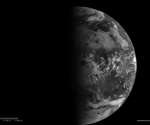
When does the line between day and night become vertical? Tomorrow. Tomorrow is an equinox on planet Earth, a time of year when day and night are most nearly equal. At an equinox, the Earth's terminator -- the dividing line between day and night -- becomes vertical and connects the north and south poles.
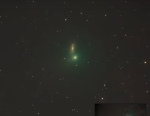 Comet Iwamoto Before Spiral Galaxy NGC 2903
19.02.2019
It isn't every night that a comet passes a galaxy. Last Thursday, though, binocular comet C/2018 Y1 (Iwamoto) moved nearly in front of a spiral galaxy of approximately the same brightness: NGC 2903. Comet Iwamoto was discovered late last year and orbits the Sun in a long ellipse.
|
January February March April May June July August |
||||||||||||||||||||||||||||||||||||||||||||||||||||||||