
|
You entered: explosion
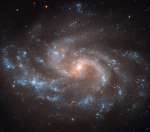 NGC 5584: Expanding the Universe
30.03.2011
Big, beautiful NGC 5548 is more that 50,000 light-years across and lies 72 million light-years away toward the constellation Virgo. The winding spiral arms of this gorgeous island universe are loaded with luminous young star clusters and dark dust lanes. Still, for earthbound astronomers NGC 5548 is not just another pretty face-on spiral galaxy.
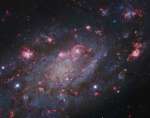 NGC 2403 in Camelopardalis
23.07.2011
Magnificent island universe NGC 2403 stands within the boundaries of the long-necked constellation Camelopardalis. Some 10 million light-years distant and about 50,000 light-years across, the spiral galaxy also seems to have more than its fair share of giant star forming HII regions, marked by the telltale reddish glow of atomic hydrogen gas.
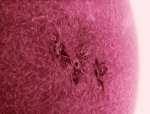 Angry Sun Erupting
14.03.2012
It's one of the baddest sunspot regions in years. Active Region 1429 may not only look, to some, like an angry bird -- it has thrown off some of the most powerful flares and coronal mass ejections of the current solar cycle.
 Tunguska: The Largest Recent Impact Event
2.10.2011
Yes, but can your meteor do this? The most powerful natural explosion in recent Earth history occurred on 1908 June 30 when a meteor exploded above the Tunguska River in Siberia, Russia. Detonating with...
 NGC 6164: A Dragon s Egg
24.04.2025
Beautiful emission nebula NGC 6164 was created by a rare, hot, luminous O-type star, some 40 times as massive as the Sun. Seen at the center of the cosmic cloud, the star is a mere 3 to 4 million years old.
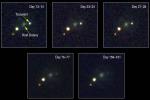 Gamma Ray Burst, Supernova Bump
17.05.2002
On the 21st of November 2001, satellites detected yet another burst of gamma-rays from the cosmos. While this flash of high-energy photons lasted for less than a minute, eager astronomers have been following the fading optical light from the location of the burst source ever since.
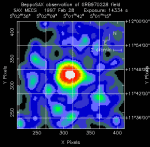 Gamma-Ray Burster
19.03.1997
What and where are the Gamma-Ray Bursters? Since their discovery in the early 1970s, nobody has been able to explain the cause of mysterious flashes of gamma rays that come from seemingly random directions on the sky.
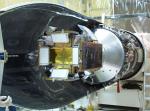 HETE-2 Rides Pegasus
12.10.2000
The Stargazer, a modified Lockheed L-1011 aircraft, soared into the skies above Kwajalein Atoll in the pacific on October 9th. A small satellite observatory known as the High Energy Transient Explorer - 2 (HETE-2) was tucked into Stargazer's winged Pegasus rocket, slung beneath the large trimotor jet's fuselage.
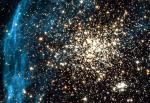 NGC 1850: Not Found in the Milky Way
12.07.2001
A mere 168,000 light-years distant, this large, lovely cluster of stars, NGC 1850, is located near the outskirts of the central bar structure in our neighboring galaxy, the Large Magellanic Cloud. A first...
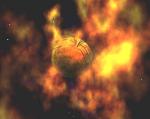 Magnetar
27.05.1998
What do you call a neutron star with a super-strong magnetic field? You guessed it ... a Magnetar. Imagine a star with more mass than the sun, the density of a neutron, and a magnetic field about a thousand trillion (a one followed by 15 zeroes) times stronger than Earth's.
|
January February March April May June July August September |
|||||||||||||||||||||||||||||||||||||||||||||||||