
|
You entered: explosion
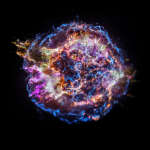 Recycling Cassiopeia A
28.12.2017
Massive stars in our Milky Way Galaxy live spectacular lives. Collapsing from vast cosmic clouds, their nuclear furnaces ignite and create heavy elements in their cores. After a few million years, the enriched material is blasted back into interstellar space where star formation can begin anew.
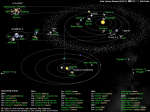 Humanity Explores the Solar System
30.04.2013
What spacecraft is humanity currently using to explore our Solar System? Presently, every inner planet has at least one robotic explorer, while several others are monitoring our Sun, some are mapping Earth's Moon, a few are chasing asteroids and comets, one is orbiting Saturn, and several are even heading out into deep space.
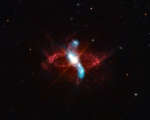 Symbiotic R Aquarii
29.06.2017
A long recognized naked-eye variable star, R Aquarii is actually an interacting binary star system, two stars that seem to have a close, symbiotic relationship. About 710 light years away, it consists of a cool red giant star and hot, dense white dwarf star in mutual orbit around their common center of mass.
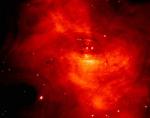 The Pulsar Powered Crab
2.06.2001
In the Summer of 1054 A.D. Chinese astronomers reported that a star in the constellation of Taurus suddenly became as bright as the full Moon. Fading slowly, it remained visible for over a year.
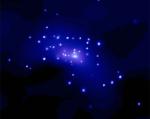 NGC 4697: X Rays from an Elliptical Galaxy
17.06.2002
The many bright, point-like sources in this Chandra Observatory x-ray image lie within NGC 4697, an elliptical galaxy some 40 million light-years away towards Virgo. Like other normal elliptical galaxies, NGC 4697 is a spherical ensemble of mainly older, fainter, low mass stars, with little star forming gas and dust compared to spiral galaxies.
 APOD: 2025 September 3 Б Cir X1: Jets in the Africa Nebula
3.09.2025
How soon do jets form when a supernova gives birth to a neutron star? The Africa Nebula provides clues. This supernova remnant surrounds Circinus X-1, an X-ray emitting neutron star and the companion star it orbits.
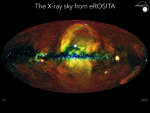 The X Ray Sky from eROSITA
23.06.2020
What if you could see X-rays? The night sky would seem a strange and unfamiliar place. X-rays are about 1,000 times more energetic than visible light photons and are produced by violent explosions and high temperature astronomical environments.
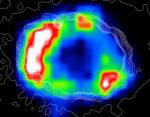 X-Ray Ring Around SN1987A
12.05.2000
This false-color image from the Chandra X-ray Observatory reveals a one light-year diameter ring of hot, ten million degree plasma. It is one of the most detailed X-ray images of the expanding blast wave from supernova 1987A (SN1987A).
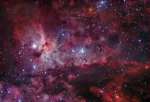 The Great Carina Nebula
9.06.2011
A jewel of the southern sky, the Great Carina Nebula, also known as NGC 3372, spans over 300 light-years, one of our galaxy's largest star forming regions. Like the smaller, more northerly Great...
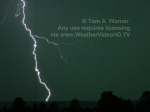 Lightning Captured at 7207 Images per Second
23.07.2012
How fast is lightning? Lightning, in fact, moves not only too fast for humans to see, but so fast that humans can't even tell which direction it is moving. The above lightning stroke did not move too fast, however, for this extremely high time resolution video to resolve.
|
January February March April May June July August September |
|||||||||||||||||||||||||||||||||||||||||||||||||