
|
You entered: explosion
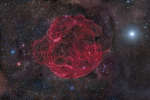 Simeis 147: Supernova Remnant
9.10.2012
It's easy to get lost following the intricate filaments in this detailed mosaic image of faint supernova remnant Simeis 147 (S147). Also cataloged as Sh2-240, it covers nearly 3 degrees or 6 full moons on the sky. That's about 150 light-years at the stellar debris cloud's estimated distance of 3,000 light-years.
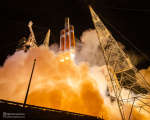 Launch of the Parker Solar Probe
15.08.2018
When is the best time to launch a probe to the Sun? The now historic answer -- which is not a joke because this really happened this past weekend -- was at night. Night, not only...
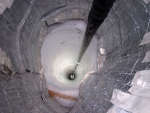 Ice Fishing for Cosmic Neutrinos
13.02.2011
Scientists are melting holes in the bottom of the world. In fact, almost 100 holes melted near the South Pole are now being used as astronomical observatories. Astronomers with the IceCube Neutrino Observatory lowered into each vertical lake a long string knotted with basketball-sized light detectors. The water in each hole soon refreezes.
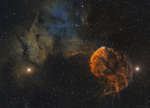 Sharpless 249 and the Jellyfish Nebula
7.03.2019
Normally faint and elusive, the Jellyfish Nebula is caught in this alluring telescopic field of view. The entire scene is a two panel mosaic constructed using narrowband image data, with emission from sulfur, hydrogen and oxygen atoms shown in red, green and blue hues.
 An Extreme Black Hole Outburst
11.03.2020
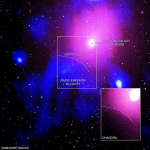
Astronomers believe they have now found the most powerful example of a black hole outburst yet seen in our Universe. The composite, false-color featured image is of a cluster of galaxies in the constellation of Ophiuchus, the serpent-bearer.
 The Jellyfish and Mars
19.05.2021
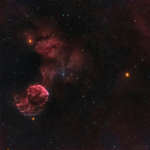
Normally faint and elusive, the Jellyfish Nebula is caught in this alluring scene. In the telescopic field of view two bright yellowish stars, Mu and Eta Geminorum, stand just below and above the Jellyfish Nebula at the left. Cool red giants, they lie at the foot of the celestial twin.
 The Gum Nebula over Snowy Mountains
27.06.2022
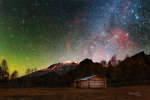
The Gum Nebula is so large and close it is actually hard to see. This interstellar expanse of glowing hydrogen gas frequently evades notice because it spans 35 degrees -- over 70 full Moons -- while much of it is quite dim.
 STARFORGE: A Star Formation Simulation
23.06.2021
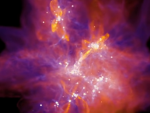
How do stars form? Most form in giant molecular clouds located in the central disk of a galaxy. The process is started, influenced, and limited by the stellar winds, jets, high energy starlight, and supernova explosions of previously existing stars.
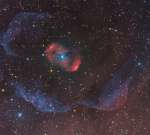 A Halo for NGC 6164
22.05.2014
Beautiful emission nebula NGC 6164 was created by a rare, hot, luminous O-type star, some 40 times as massive as the Sun. Seen at the center of the cosmic cloud, the star is a mere 3 to 4 million years old.
 APOD: 2024 April 3 Б Unusual Nebula Pa 30
3.04.2024
What created this unusual celestial firework? The nebula, dubbed Pa 30, appears in the same sky direction now as a bright "guest star" did in the year 1181. Although Pa 30's filaments look...
|
January February March April May June July August September |
|||||||||||||||||||||||||||||||||||||||||||||||||