
|
You entered: sky
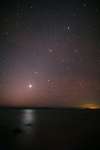 Ecliptic New Zealand
10.07.2010
Four bright celestial beacons and a faint triangle of light follow the plane of the ecliptic as it arcs high through this southern hemisphere night skyscape. Seen on a July winter night from Lake...
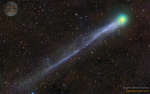 Comet Lovejoy s Tail
16.01.2015
Sweeping north in planet Earth's sky, Comet Lovejoy's greenish coma and blue tinted ion tail stretched across this field of stars in the constellation Taurus on January 13. The inset at the upper left shows the 1/2 degree angular size of the full moon for scale.
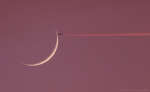 Fly Me to the Moon
16.01.2017
No, this is not a good way to get to the Moon. What is pictured is a chance superposition of an airplane and the Moon. The contrail would normally appear white, but the large volume of air toward the setting Sun preferentially knocks away blue light, giving the reflected trail a bright red hue.
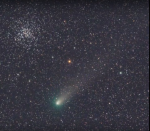 Salt Pepper and Ice
17.09.2018
There's a "camera" comet now moving across the sky. Just a bit too dim to see with the unaided eye, Comet 21P / Giacobini-Zinner has developed a long tail that makes it a good sight for binoculars and sensitive cameras.
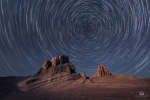 Star Trails for a Red Planet
29.11.2019
Does Mars have a north star? In long exposures of Earth's night sky, star trails make concentric arcs around the north celestial pole, the direction of our fair planet's axis of rotation. Bright star Polaris is presently the Earth's North Star, close on the sky to Earth's north celestial pole.
 Crepuscular Moon Rays over Denmark
26.07.2022
This moon made quite an entrance. Typically, a moonrise is quiet and serene. Taking a few minutes to fully peek above the horizon, Earth's largest orbital companion can remain relatively obscure until it rises high in the nighttime sky.
 Gamma Ray Bursts from the Unknown
22.11.1996
Gamma Ray Bursts (GRBs) pose one of the greatest mysteries of modern astronomy. About once a day, the gamma-ray sky lights up with a spectacular explosion. No one knows what causes these explosions or even how far away they are.
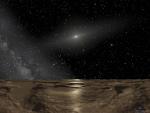 Sedna at Noon
4.06.2004
Standing on Sedna - the solar system's most distant known planetoid - your view of the Sun at high noon might look something like this. An artist's dramatic vision, the picture shows the Sun suspended above the nearby horizon as a bright star immersed in the dusty ecliptic plane.
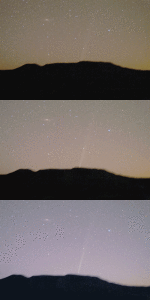 Comet Bradfield Rising
27.04.2004
Comet Bradfield has become quite a sight just before sunrise -- for those with binoculars or cameras. Although fading noticeably each day, a sky chart, a northern location, and some persistence will allow curious sky gazers to locate the cosmic snowball and its spectacular tail.
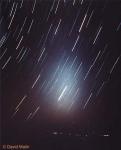 Zodiacal Light
13.06.1999
Sometimes the sky itself seems to glow. Usually, this means you are seeing a cloud reflecting sunlight or moonlight. If the glow appears as a faint band of light running across the whole sky, you are probably seeing the combined light from the billions of stars that compose our Milky Way Galaxy.
|
January February March April May June July August September October |
|||||||||||||||||||||||||||||||||||||||||||||||||