
|
You entered: sky
 Iridescent by Moonlight
4.12.2021
In this snapshot from November 18, the Full Moon was not far from Earth's shadow. In skies over Sicily the brightest lunar phase was eclipsed by passing clouds though. The full moonlight was dimmed and momentarily diffracted by small but similar sized water droplets near the edges of the high thin clouds.
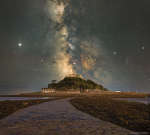 The Milky Way over St Michaels Mount
7.09.2020
Where do land and sky converge? On every horizon -- but in this case the path on the ground leads to St Michael's Mount (Cornish: Karrek Loos yn Koos), a small historic island in Cornwall, England. The Mount is usually surrounded by shallow water, but at low tide is spanned by a human-constructed causeway.
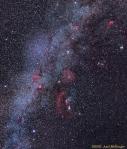 Clusters and Nebulae of the Hexagon
4.04.2003
At first, the bright stars of the large asterism known as the (northern) Winter Hexagon might be hard to pick out in this gorgeous deep sky mosaic from December 2002. But placing your cursor...
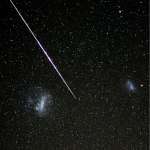 Meteor between the Clouds
20.11.2009
This bright meteor streaked through dark night skies over Sutherland, South Africa on November 15. Potentially part of the annual Leonid meteor shower, its sudden, brilliant appearance, likened to a camera's flash, was captured by chance as it passed between two clouds.
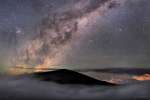 Over the Top
19.06.2014
The central bulge of our Milky Way Galaxy rises above a sea of clouds in this ethereal scene. An echo of the Milky Way's dark dust lanes, the volcanic peak in foreground silhouette is on France's Réunion Island in the southern Indian Ocean.
 Good Morning Moon
12.01.2024
Yesterday, the Moon was New. But on January 9, early morning risers around planet Earth were treated to the sight of an old Moon, low in the east as the sky grew bright before dawn.
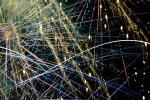 Fireworks and Shooting Stars
9.08.2002
Experimenting with a new telescope and camera, photographer Jim Steele captured this surreal but festive image of fireworks in the night sky above Ashland, Oregon. The date was July 4th and the fiery streaks were part of the traditional annual celebration of independence day in the United States.
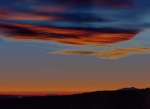 Mercury on the Horizon
19.02.2013
Have you ever seen the planet Mercury? Because Mercury orbits so close to the Sun, it never wanders far from the Sun in Earth's sky. If trailing the Sun, Mercury will be visible low on the horizon for only a short while after sunset.
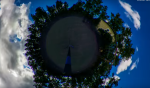 Tiny Planet Timelapse
8.12.2018
You can pack a lot of sky watching into 30 seconds on this tiny planet. Of course, the full spherical image timelapse video was recorded on planet Earth, from Grande Pines Observatory outside Pinehurst, North Carolina.
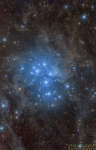 Pleiades: The Seven Sisters Star Cluster
9.09.2020
Have you ever seen the Pleiades star cluster? Even if you have, you probably have never seen it as large and clear as this. Perhaps the most famous star cluster on the sky, the bright stars of the Pleiades can be seen without binoculars from even the depths of a light-polluted city.
|
January February March April May June July August September October |
|||||||||||||||||||||||||||||||||||||||||||||||||