
|
You entered: sky
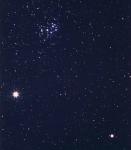 Jupiter, Saturn and Messier 45
22.03.2001
Brilliant Venus falls out of the evening sky as March ends, but Jupiter and Saturn remain well up above the western horizon. Jupiter blazes forth above and to the left of a slightly fainter Saturn in this telephoto picture taken on January 19th.
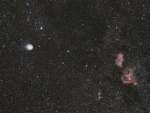 A Year of Spectacular Comets
31.12.2007
Two spectacular comets graced Earth's skies during 2007. Both comets became bright enough to be seen by the unaided eye of the casual sky enthusiast. Early in 2007, Comet McNaught grew brighter than any comet in 40 years, displaying a beautiful dust tail that flowed across the sky.
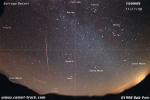 An Annotated Leonid
11.11.2001
The 1998 Leonids Meteor Shower was one of the most photographed meteor event in history. Patient observers saw bright meteors streak across dark skies every few minutes, frequently leaving fading trails stretching across the sky. High above the Anza-Borrego Desert, a meteor was photographed streaking up from the radiant constellation of the Leonids: Leo.
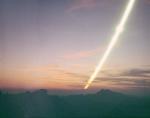 A Setting Sun Trail
29.07.2002
The Sun appears to move on the sky because the Earth rotates. The extreme brightness of the Sun, however, makes it difficult to capture a sun-trail -- the path the Sun traces on the sky.
 Planets and Fire by Moonlight
9.07.2008
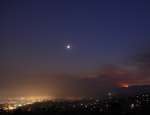
On July 5th, wandering planets, bright stars, and a young crescent Moon graced western skies after sunset. Arrayed along the solar system's ecliptic plane, the three celestial beacons forming this skyscape's eye-catching line-up with the Moon are Saturn (upper left), then Mars, and finally Regulus, alpha star of the constellation Leo.
 Planets in the West
18.04.2002
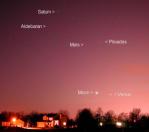
Have you seen any bright planets lately? Chances are if you've been outside under clear skies just after sunset, then you have. Now shining in the west as bright "stars" in the night sky, are all five planets of the solar system known to ancient astronomers - Mercury, Venus, Mars, Saturn, and Jupiter.
 GLOBE at Night: Help Track Light Pollution
18.03.2009
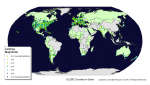
How many stars can you see? Through next week, the GLOBE at Night project invites people from all over the world to go outside at night, look up, and see! Specifically, people are invited to go out an hour after sunset and look for the constellation Orion toward the west.
 Microwave Milky Way
9.07.2010
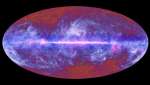
Seen from our edge-on perspective, the Milky Way Galaxy sprawls across the middle of this false-color, all sky view. The expansive microwave map is based on 1 year's worth of data from instruments onboard the sky-surveying Planck spacecraft.
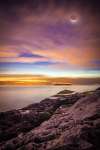 Moon, Venus, and Planet Earth
19.09.2013
In this engaging scene from planet Earth, the Moon shines through cloudy skies following sunset on the evening of September 8. Despite the fading light, the camera's long exposure still recorded a colorful, detailed view of a shoreline and western horizon looking toward the island San Gabriel from Colonia del Sacramento, Uruguay.
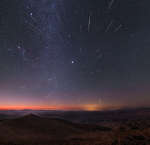 Geminid Meteors over Chile
23.12.2013
From a radiant point in the constellation of the Twins, the annual Geminid meteor shower rained down on planet Earth over the past few weeks. Recorded near the shower's peak over the night...
|
January February March April May June July August September October |
|||||||||||||||||||||||||||||||||||||||||||||||||