
|
You entered: sky
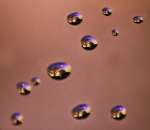 Venus Through Water Drops
27.01.2017
Now the brilliant "star" in planet Earth's evening skies, Venus is captured in this creative astrophotograph. Taken with a close-focusing lens on January 18 from Milton Keynes, UK, it shows multiple images of the sky above the western horizon shortly after sunset.
 Tololo Totality
15.03.2025
On March 14 the Moon was Full. In an appropriate celebration of Pi day, that put the Moon 3.14 radians (180 degrees) in ecliptic longitude from the Sun in planet Earth's sky.
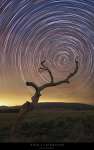 APOD: 2026 April 16 Б South Celestial Tree
16.04.2026
If you live in the northern hemisphere, you may have learned how to locate the North Star, Polaris, in the night sky. It can be used to find north, and it approximately marks the northern celestial pole.
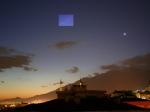 Venus and Comet Pojmanski
3.03.2006
Shining brightly in the east at dawn, Venus dominates the sky in this view over a suburban landscape from Bursa, Turkey. An otherwise familiar scene for astronomer Tunc Tezel, his composite picture of the morning sky recorded on March 2nd also includes a surprise visitor to the inner solar system, Comet Pojmanski.
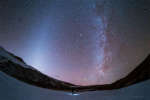 Dueling Bands in the Night
1.03.2022
What are these two bands in the sky? The more commonly seen band is the one on the right and is the central band of our Milky Way galaxy. Our Sun orbits...
 The Great Meteor Procession of 1913
9.02.2013
One hundred years ago today the Great Meteor Procession of 1913 occurred, a sky event described by some as "magnificent" and "entrancing" and which left people feeling "spellbound" and "privileged". Because one had to be in a right location, outside, and under clear skies, only about 1,000 people noted seeing the procession.
 APOD: 2026 July 24 Б RCW 86: Historical Supernova Remnant
24.07.2026
In 185 AD, Chinese astronomers recorded the appearance of a new star in the Nanmen asterism. That part of the sky is identified with part of the southern constellation Centaurus on modern star charts.
 Evidence for Frame Dragging Black Holes
7.11.1997
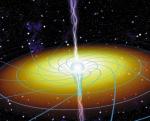
Gravity can do more than floor you. According to recent measurements of a star system thought to contain a black hole, it can spin you too. This effect, called frame-dragging, is most prominent near massive, fast spinning objects. Now, a team led by W.
 Moons and Jupiter
14.07.2009
Earth's Moon and planet Jupiter made a beautiful pairing in the night sky late last week. This skyscape recorded on July 11 from Brittany in north western France captures the bright conjunction through a cloud bank.
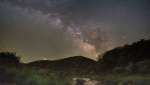 Countryside Mars and Milky Way
9.06.2018
Mars shines brightly now in planet Earth's sky. Seen with a yellowish hue it rises over the hills and far away in this serene night skyscape, a countryside panorama recorded last month from Parque Nacional de Cabaneros in Spain. The Milky Way too extends above the distant hills into a starry sky.
|
January February March April May June July August September October |
|||||||||||||||||||||||||||||||||||||||||||||||||