
|
You entered: color
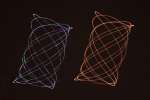 Scintillating
28.04.2011
On June 4, 2010 Regulus, alpha star of the constellation Leo, and wandering planet Mars were at about the same apparent brightness, separated on the sky by 1.5 degrees. An ingenious and creative 10 second exposure from a swinging camera recorded these gyrating trails of the celestial pairing.
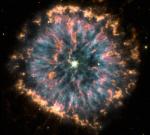 Celebrating Hubble With NGC 6751
7.04.2000
Planetary nebulae do look simple, round, and planet-like in small telescopes. But images from the orbiting Hubble Space Telescope have become well known for showing these fluorescent gas shrouds of dying Sun-like stars to possess a staggering variety of detailed symmetries and shapes.
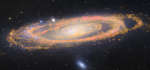 The Infrared Visible Andromeda
12.12.2014
This remarkable synthetic color composite image was assembled from archives of visible light and infrared astronomy image data. The field of view spans the Andromeda Galaxy (M31), a massive spiral a mere 2.5 million light-years away. In fact, with over twice the diameter of our own Milky Way, Andromeda is the largest nearby galaxy.
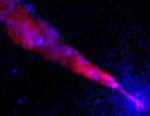 The Energetic Jet from Centaurus A
1.05.2003
The center of well-studied active galaxy Centaurus A is hidden from the view of optical telescopes by a cosmic jumble of stars, gas, and dust. But both radio and x-ray telescopes can trace the remarkable jet of high-energy particles streaming from the galaxy's core.
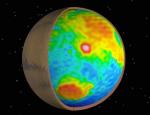 Inside Mars
22.03.2000
What's inside Mars? From orbit, the Mars Global Surveyor (MGS) spacecraft has recorded detailed images of the red planet since July 1997. Still, its cameras can not look beneath the surface. But minute...
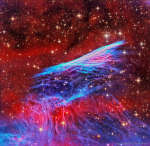 The Pencil Nebula Supernova Shock Wave
13.04.2021
This supernova shock wave plows through interstellar space at over 500,000 kilometers per hour. Near the middle and moving up in this sharply detailed color composite, thin, bright, braided filaments are actually long ripples in a cosmic sheet of glowing gas seen almost edge-on.
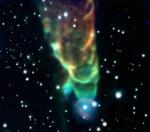 Cosmic Tornado HH 49 50
11.08.2007
Light-years in length, this cosmic tornado is actually a powerful jet cataloged as HH (Herbig-Haro) 49/50 blasting down from the top of a Spitzer Space Telescope view. Though such energetic outflows are well known...
 APOD: 2023 July 31 Б Phobos over Mars
30.07.2023
Why is Phobos so dark? Phobos, the largest and innermost of the two Martian moons, is the darkest moon in the entire Solar System. Its unusual orbit and color indicate that it may be a captured asteroid composed of a mixture of ice and dark rock.
 APOD: 2024 August 21 Б Fermis 12 year All Sky Gamma ray Map
20.08.2024
Forget X-ray vision Б imagine what you could see with gamma-ray vision! The featured all-sky map shows what the universe looks like to NASA's Fermi Gamma-ray Space Telescope. Fermi sees light with energies about a billion times what the human eye can see, and the map combines 12 years of Fermi observations.
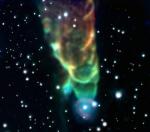 Cosmic Tornado HH 49 50
2.02.2006
Light-years in length, this cosmic tornado is actually a powerful jet cataloged as HH (Herbig-Haro) 49/50 blasting down from the top of a Spitzer Space Telescope view. Though such energetic outflows are well known...
|
January February March April May June July August September October |
|||||||||||||||||||||||||||||||||||||||||||||||||