
|
You entered: color
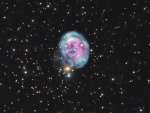 NGC 7008: The Fetus Nebula
25.08.2008
Compact and round, NGC 7008 is recognized as a planetary nebula about 2,800 light-years distant in the nebula rich constellation of Cygnus. This impressive telescopic view shows off NGC 7008's remarkable colors...
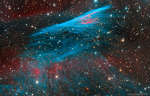 The Pencil Nebula in Red and Blue
13.08.2018
This shock wave plows through interstellar space at over 500,000 kilometers per hour. Near the top and moving up in this sharply detailed color composite, thin, bright, braided filaments are actually long ripples in a cosmic sheet of glowing gas seen almost edge-on.
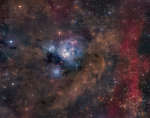 Young Suns of NGC 7129
16.10.2025
Young suns still lie within dusty NGC 7129, some 3,000 light-years away toward the royal constellation Cepheus. While these stars are at a relatively tender age, only a few million years old, it is likely that our own Sun formed in a similar stellar nursery around five billion years ago.
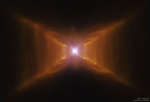 APOD: 2026 January 5 Б The Red Rectangle Nebula from Hubble
5.01.2026
How was the unusual Red Rectangle nebula created? At the nebula's center is an aging binary star system that surely powers the nebula but does not, as yet, explain its colors. The unusual...
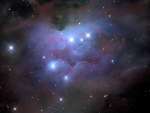 Reflections on the 1970s
20.12.2007
The 1970s are sometimes ignored by astronomers. In particular, this beautiful grouping of reflection nebulae in Orion - NGC 1977, NGC 1975, and NGC 1973 - are usually overlooked in favor of the substantial glow from the nearby stellar nursery better known as the Orion Nebula.
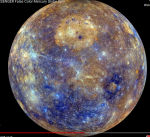 All of Mercury
28.04.2019
Only six years ago, the entire surface of planet Mercury was finally mapped. Detailed observations of the innermost planet's surprising crust began when the robotic have been ongoing since the robotic MESSENGER spacecraft first passed Mercury in 2008 and continued until its controlled crash landing in 2015.
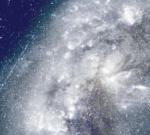 Bright Star Knots in NGC 4038
2.06.1997
This galaxy is having a bad millennium. In fact, the past 100 million years haven't been so good, and probably the next billion or so should be quite tumultuous. NGC 4039 was a normal spiral galaxy, minding its own business, when NGC 4038 crashed into it.
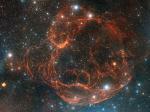 Simeis 147: Supernova Remnant from Palomar
29.11.2005
It's easy to get lost following the intricate filaments in this detailed image of faint supernova remnant Simeis 147. Seen towards the constellation Taurus it covers nearly 3 degrees (6 full moons) on the sky corresponding to a width of 150 light-years at the stellar debris cloud's estimated distance of 3,000 light-years.
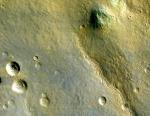 Mars: The View from HiRISE
10.04.2006
HiRISE - the High Resolution Imaging Science Experiment - rides on the Mars Reconnaissance Orbiter (MRO)spacecraft just arrived in Mars orbit on March 10. This sharp view of the martian surface from the HiRISE camera includes image data with a full resolution of about 2.5 meters per pixel - recorded from a range of 2,500 kilometers.
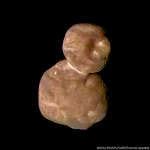 Ultima Thule from New Horizons
29.01.2019
How do distant asteroids differ from those near the Sun? To help find out, NASA sent the robotic New Horizons spacecraft past the classical Kuiper belt object 2014 MU69, nicknamed Ultima Thule, the farthest asteroid yet visited by a human spacecraft.
|
January February March April May June July August September October |
|||||||||||||||||||||||||||||||||||||||||||||||||