
|
You entered: color
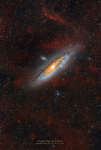 Clouds of Andromeda
4.01.2017
The beautiful Andromeda Galaxy is often imaged by planet Earth-based astronomers. Also known as M31, the nearest large spiral galaxy is a familiar sight with dark dust lanes, bright yellowish core, and spiral arms traced by blue starlight.
 APOD: 2024 July 24 Б Exaggerated Moon
24.07.2024
Our Moon doesn't really have craters this big. Earth's Moon, Luna, also doesn't naturally show this spikey texture, and its colors are more subtle. But this digital creation is based on reality.
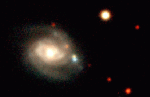 Star Wars in NGC 664
25.02.1997
Long ago in a galaxy far, far away, locked in their final desperate struggle against the force of gravity ... two stars exploded! Stellar explosions - Supernovae - are among the most powerful events in the Universe, estimated to release an equivalent energy of up to 1 million trillion trillion (1 followed by 30 zeros) megatons of TNT.
 Star Wars in NGC 664
18.04.1998
Long ago in a galaxy far, far away, locked in their final desperate struggle against the force of gravity ... two stars exploded! stellar explosions - Supernovae - are among the most powerful events in the Universe, estimated to release an equivalent energy of up to 1 million trillion trillion (1 followed by 30 zeros) megatons of TNT.
 Star Wars in NGC 664
15.05.1999
Long ago in a galaxy far, far away, locked in their final desperate struggle against the force of gravity ... two stars exploded! stellar explosions - Supernovae - are among the most powerful events in the Universe, estimated to release an equivalent energy of up to 1 million trillion trillion (1 followed by 30 zeros) megatons of TNT.
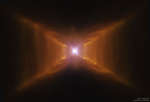 The Red Rectangle Nebula from Hubble
9.05.2018
How was the unusual Red Rectangle nebula created? At the nebula's center is an aging binary star system that surely powers the nebula but does not, as yet, explain its colors. The unusual...
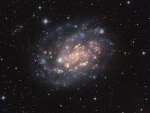 NGC 300: A Cosmic Gemstone with Stars and Gas Clouds
16.07.2026
This sparkling, colorful gemstone is a spiral galaxy, NGC 300. It is one of the closest spiral galaxies to Earth, only about 6 million light-years away. But does it really look like this? Here is a more standard portrait of it.
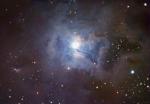 NGC 7023: The Iris Nebula
4.11.2004
Like delicate cosmic petals, these clouds of interstellar dust and gas have blossomed 1,300 light-years away in the fertile star fields of the constellation Cepheus. Sometimes called the Iris Nebula and dutifully cataloged as NGC 7023, this is not the only nebula in the sky to evoke the imagery of flowers.
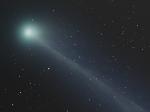 The Ghostly Tail of Comet SWAN
6.11.2006
What causes the structure in Comet SWAN's tail? Comet SWAN, which unexpectedly flared up to naked-eye brightness last week, has been showing detail in its ion tail that might be described as ghostly.
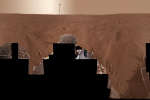 A Mars Panorama from the Phoenix Lander
12.08.2008
If you could stand on Mars, what would you see? The robotic Phoenix spacecraft that just landed on Mars in May recorded the above spectacular panorama. The above image is actually a digital combination of over 100 camera pointings and surveys fully 360 degrees around the busy robotic laboratory.
|
January February March April May June July August September October |
|||||||||||||||||||||||||||||||||||||||||||||||||