
|
You entered: gas
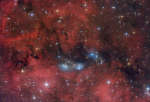 The NGC 6914 Complex
7.07.2022
A study in contrasts, this colorful skyscape features stars, dust, and glowing gas in the vicinity of NGC 6914. The interstellar complex of nebulae lies some 6,000 light-years away, toward the high-flying northern constellation Cygnus and the plane of our Milky Way Galaxy.
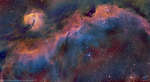 The Seagull Nebula
19.01.2023
A broad expanse of glowing gas and dust presents a bird-like visage to astronomers from planet Earth, suggesting its popular moniker - The Seagull Nebula. Using narrowband image data, this 3-panel mosaic of the cosmic...
 APOD: 2023 June 11 Б The Sun and Its Missing Colors
11.06.2023
Here are all the visible colors of the Sun, produced by passing the Sun's light through a prism-like device. The spectrum was created at the McMath-Pierce Solar Observatory and shows, first off, that although our white-appearing Sun emits light of nearly every color, it appears brightest in yellow-green light.
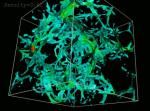 The Lyman Alpha Forest
12.11.2000
We live in a forest. Strewn throughout the universe are "trees" of hydrogen gas that absorb light from distant objects. These gas clouds leave numerous absorption lines in a distant quasar's spectra, together called the Lyman-alpha forest.
 In the Vicinity of the Cone Nebula
23.11.2008
Strange shapes and textures can be found in neighborhood of the Cone Nebula. The unusual shapes originate from fine interstellar dust reacting in complex ways with the energetic light and hot gas being expelled by the young stars.
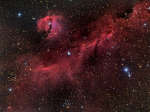 The Seagull Nebula
8.03.2012
A broad expanse of glowing gas and dust presents a bird-like visage to astronomers from planet Earth, suggesting its popular moniker - The Seagull Nebula. This portrait of the cosmic bird covers a 1.6 degree wide swath across the plane of the Milky Way, near the direction of Sirius, alpha star of the constellation Canis Major.
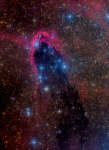 The Dark Tower in Scorpius
15.07.2021
In silhouette against a crowded star field along the tail of the arachnalogical constellation Scorpius, this dusty cosmic cloud evokes for some the image of an ominous dark tower. In fact, clumps of dust...
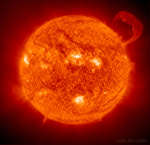 A Solar Prominence from SOHO
30.01.2022
How can gas float above the Sun? Twisted magnetic fields arching from the solar surface can trap ionized gas, suspending it in huge looping structures. These majestic plasma arches are seen as prominences above the solar limb.
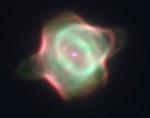 Hen 1357: New Born Nebula
6.10.2001
This Hubble Space Telescope snapshot shows Hen-1357, the youngest known planetary nebula. Graceful, gentle curves and symmetry suggest its popular name - The Stingray Nebula. Observations in the 1970s detected no nebular material, but this image from March 1996 clearly shows the Stingray's emerging bubbles and rings of shocked and ionized gas.
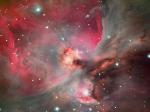 The Great Nebula in Orion
13.02.2002
Few astronomical sights excite the imagination like the nearby stellar nursery known as the Orion Nebula. The Nebula's glowing gas surrounds hot young stars at the edge of an immense interstellar molecular cloud only 1500 light-years away.
|
January February March April May June July August September October |
|||||||||||||||||||||||||||||||||||||||||||||||||