
|
You entered: gas
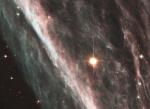 APOD: 2003 June 9 Ш The Pencil Nebula Supernova Shockwave
9.06.2003
At 500,000 kilometers per hour, a supernova shockwave plows through interstellar space. This shockwave is known as the Pencil Nebula, or NGC 2736, and is part of the Vela supernova remnant, an expanding shell of a star that exploded about 11,000 years ago.
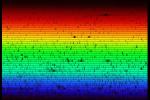 The Solar Spectrum
27.02.2005
It is still not known why the Sun's light is missing some colors. Shown above are all the visible colors of the Sun, produced by passing the Sun's light through a prism-like device.
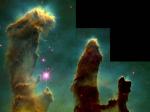 M16: Pillars of Creation
18.02.2007
It has become one of the most famous images of modern times. This image, taken with the Hubble Space Telescope in 1995, shows evaporating gaseous globules (EGGs) emerging from pillars of molecular hydrogen gas and dust.
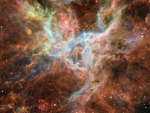 In the Heart of the Tarantula Nebula
31.03.2009
In the heart of monstrous Tarantula Nebula lies huge bubbles of energetic gas, long filaments of dark dust, and unusually massive stars. In the center of this heart, is a knot of stars so dense that it was once thought to be a single star.
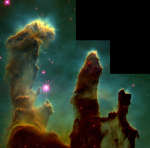 M16: Pillars of Creation
28.03.2010
It has become one of the most famous images of modern times. This image, taken with the Hubble Space Telescope in 1995, shows evaporating gaseous globules (EGGs) emerging from pillars of molecular hydrogen gas and dust.
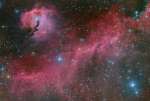 The Seagull Nebula
29.08.2015
A broad expanse of glowing gas and dust presents a bird-like visage to astronomers from planet Earth, suggesting its popular moniker - The Seagull Nebula. This portrait of the cosmic bird covers a 1.6 degree wide swath across the plane of the Milky Way, near the direction of Sirius, alpha star of the constellation Canis Major.
 APOD: 2024 May 21 Б CG4: The Globule and the Galaxy
21.05.2024
Can a gas cloud eat a galaxy? It's not even close. The "claw" of this odd looking "creature" in the featured photo is a gas cloud known as a cometary globule. This globule, however, has ruptured. Cometary globules are typically characterized by dusty heads and elongated tails.
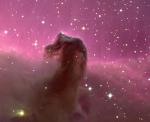 The Horsehead Nebula
19.05.1999
One of the most identifiable nebulae in the sky, the Horsehead Nebula in Orion, is part of a large, dark, molecular cloud. Also known as Barnard 33, the unusual shape was first discovered on a photographic plate in the late 1800s.
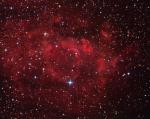 Stars and the Bubble Nebula
17.01.2003
Seemingly adrift in an cosmic sea of stars and gas, this delicate, floating apparition is cataloged as NGC 7635 -- The Bubble Nebula. In this wide-angle view, the Bubble nebula lies at the center of a larger complex of shocked glowing gas about 11,000 light-years distant in the fair constellation Cassiopeia.
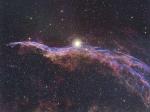 NGC 6960: The Witchs Broom Nebula
2.03.2004
Ten thousand years ago, before the dawn of recorded human history, a new light must suddenly have appeared in the night sky and faded after a few weeks. Today we know this light was an exploding star and record the colorful expanding cloud as the Veil Nebula.
|
January February March April May June July August September October |
|||||||||||||||||||||||||||||||||||||||||||||||||