
|
You entered: gas
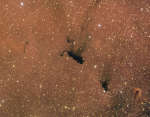 Molecular Cloud Barnard 163
1.05.2011
It may look to some like a duck, but it lays stars instead of eggs. In the center of the above image lies Barnard 163, a nebula of molecular gas and dust so thick that visible light can't shine through it.
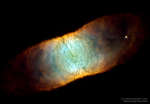 IC 4406: A Seemingly Square Nebula
8.01.2017
How can a round star make a square nebula? This conundrum comes to light when studying planetary nebulae like IC 4406. Evidence indicates that IC 4406 is likely a hollow cylinder, with its square appearance the result of our vantage point in viewing the cylinder from the side.
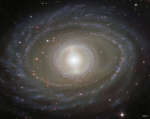 Ribbons and Pearls of Spiral Galaxy NGC 1398
23.01.2018
Why do some spiral galaxies have a ring around the center? Spiral galaxy NGC 1398 not only has a ring of pearly stars, gas and dust around its center, but a bar of stars and gas across its center, and spiral arms that appear like ribbons farther out.
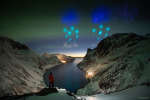 AZURE Vapor Tracers over Norway
8.04.2019
What's happening in the sky? The atmosphere over northern Norway appeared quite strange for about 30 minutes last Friday when colorful clouds, dots, and plumes suddenly appeared. The colors were actually created by the NASA-funded Auroral Zone Upwelling Rocket Experiment (AZURE) which dispersed gas tracers to probe winds in Earth's upper atmosphere.
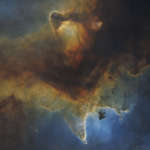 The Central Soul Nebula Without Stars
10.11.2020
This cosmic close-up looks deep inside the Soul Nebula. The dark and brooding dust clouds near the top, outlined by bright ridges of glowing gas, are cataloged as IC 1871. About 25 light-years across, the telescopic field of view spans only a small part of the much larger Heart and Soul nebulae.
 APOD: 2024 October 27 Б LDN 43: The Cosmic Bat Nebula
27.10.2024
What is the most spook-tacular nebula in the galaxy? One contender is LDN 43, which bears an astonishing resemblance to a vast cosmic bat flying amongst the stars on a dark Halloween night. Located...
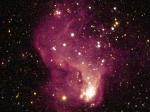 Star Forming Region Hubble V
25.12.2001
How did stars form in the early universe? Astronomers are gaining insight by studying NGC 6822, a nearby galaxy classified as irregular by modern standards but appearing more typical of galaxies billions of years ago. Inspection of NGC 6822 shows several bright star groups, including two dubbed Hubble-X and Hubble-V.
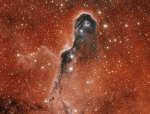 An Unusual Globule in IC 1396
14.04.2014
Is there a monster in IC 1396? Known to some as the Elephant's Trunk Nebula, parts of gas and dust clouds of this star formation region may appear to take on foreboding forms, some nearly human. The only real monster here, however, is a bright young star too far from Earth to hurt us.
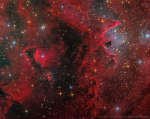 IC 1871: Inside the Soul Nebula
28.11.2018
This cosmic close-up looks deep inside the Soul Nebula. The dark and brooding dust clouds on the left, outlined by bright ridges of glowing gas, are cataloged as IC 1871. About 25 light-years across, the telescopic field of view spans only a small part of the much larger Heart and Soul nebulae.
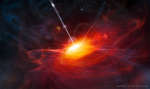 Illustration: An Early Quasar
22.02.2022
What did the first quasars look like? The nearest quasars are now known to involve supermassive black holes in the centers of active galaxies. Gas and dust that falls toward a quasar glows brightly, sometimes outglowing the entire home galaxy.
|
January February March April May June July August September October |
|||||||||||||||||||||||||||||||||||||||||||||||||