
|
You entered: gas
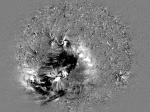 The Sun Puffs
29.10.2006
Our Earth endures bursts of particles from the Sun. On 1997 April 7, at 10 am (EDT), ground monitors of the SOHO spacecraft, which continually monitors the Sun, noticed a weak spot in the solar corona was buckling again, this time letting loose a large, explosive Coronal Mass Ejection (CME).
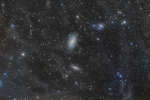 The M81 Galaxy Group Through the Integrated Flux Nebula
12.05.2008
Large galaxies and faint nebula highlight this deep image of the M81 Group of galaxies. First and foremost in the above wide-angle 12-hour exposure is the grand design spiral galaxy M81, the largest galaxy visible in the image.
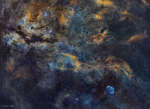 Central Cygnus Skyscape
19.08.2015
In cosmic brush strokes of glowing hydrogen gas, this beautiful skyscape unfolds across the plane of our Milky Way Galaxy and the center of the northern constellation Cygnus the Swan. The featured image spans about six degrees.
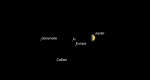 Juno Approaching Jupiter
1.07.2016
Approaching over the north pole after nearly a five-year journey, Juno enjoys a perspective on Jupiter not often seen, even by spacecraft from Earth that usually swing by closer to Jupiter's equator. Looking...
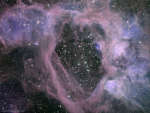 The N44 Superbubble
25.06.2017
What created this gigantic hole? The vast emission nebula N44 in our neighboring galaxy the Large Magellanic Cloud has a large, 250 light-year hole and astronomers are trying to figure out why. One possibility is particle winds expelled by massive stars in the bubble's interior that are pushing out the glowing gas.
 APOD: 2023 July 12 Б Rings and Bar of Spiral Galaxy NGC 1398
12.07.2023
Why do some spiral galaxies have a ring around the center? Spiral galaxy NGC 1398 not only has a ring of pearly stars, gas and dust around its center, but a bar of stars and gas across its center, and spiral arms that appear like ribbons farther out.
 APOD: 2024 October 22 Б M16: Pillars of Star Creation
22.10.2024
These dark pillars may look destructive, but they are creating stars. This pillar-capturing picture of the Eagle Nebula combines visible light exposures taken with the Hubble Space Telescope with infrared images taken with the James Webb Space Telescope to highlight evaporating gaseous globules (EGGs) emerging from pillars of molecular hydrogen gas and dust.
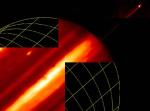 Jupiter: Moon, Ring, and Clouds
21.11.1997
An inner moon, an edge-on, planet-girdling ring, and high altitude cloud bands are visible in this mosaic of infrared images of gas giant Jupiter. The moon Metis, 25 miles wide and about 80,000 miles from the planet, is the bright spot at the upper right.
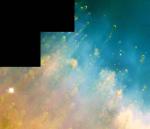 At the Edge of the Helix Nebula
12.05.2002
While exploring the inner edge of the Helix Nebula with the Hubble Space Telescope's Wide Field Planetary Camera 2, astronomers were able to produce this striking image - rich in details of an exotic environment.
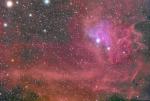 IC 405: The Flaming Star Nebula
24.11.2003
Rippling dust and gas lanes give the Flaming Star Nebula its name. The red and purple colors of the nebula are present in different regions and are created by different processes. The bright star...
|
January February March April May June July August September October |
|||||||||||||||||||||||||||||||||||||||||||||||||