
|
You entered: background
 APOD: 2024 October 13 Б Aurora Timelapse Over Italian Alps
12.10.2024
Did you see last night's aurora? This question was relevant around much of the world a few days ago because a powerful auroral storm became visible unusually far from the Earth's poles.
 APOD: 2024 November 6 Б Comet Tsuchinshan Atlas over the Dolomites
5.11.2024
Comet Tsuchinshan-Atlas is now headed back to the outer Solar System. The massive dusty snowball put on quite a show during its trip near the Sun, resulting in many impressive pictures from planet Earth during October. The featured image was taken in mid-October and shows a defining visual feature of the comet -- its impressive anti-tail.
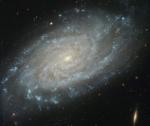 NGC 3370: A Sharper View
11.09.2003
Similar in size and grand design to our own Milky Way, spiral galaxy NGC 3370 lies about 100 million light-years away toward the constellation Leo. Recorded here in exquisite detail by the Hubble Space...
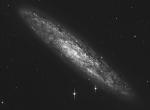 Spiral Galaxy NGC 253
20.01.1999
A camera with over 67 million pixels (digital picture elements) was used to record this stunning image of spiral galaxy NGC 253. Known as the Wide Field Imager (WFI), the camera is the latest instrument to be installed at the European Southern Observatory's 2.2 meter telescope in La Silla, Chile.
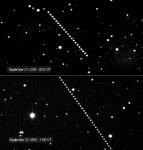 Toutatis Nears Planet Earth
2.10.2004
On Wednesday, September 29, asteroid Toutatis came within one million miles of Earth -- the closest predicted aproach of a sizable asteroid or comet to our fair planet in this century. Coming within one million...
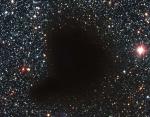 Molecular Cloud Barnard 68
18.12.2004
Where did all the stars go? What used to be considered a hole in the sky is now known to astronomers as a dark molecular cloud. Here, a high concentration of dust and molecular gas absorb practically all the visible light emitted from background stars.
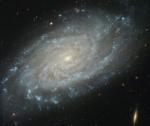 NGC 3370: A Sharper View
14.05.2005
Similar in size and grand design to our own Milky Way, spiral galaxy NGC 3370 lies about 100 million light-years away toward the constellation Leo. Recorded here in exquisite detail by the Hubble Space...
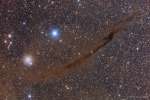 NGC 4372 and the Dark Doodad
31.01.2013
The delightful Dark Doodad Nebula drifts through southern skies, a tantalizing target for binoculars in the constellation Musca, The Fly. The dusty cosmic cloud is seen against rich starfields just south of the prominent Coalsack Nebula and the Southern Cross.
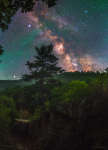 Firefly Milky Way over Russia
5.09.2021
It started with a pine tree. The idea was to photograph a statuesque pine in front of the central band of our Milky Way Galaxy. And the plan, carried out two months ago, was successful -- they both appear prominently. But the resulting 3-frame panorama captured much more.
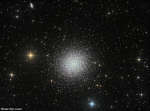 M13: The Great Globular Cluster in Hercules
3.08.2022
In 1716, English astronomer Edmond Halley noted, "This is but a little Patch, but it shows itself to the naked Eye, when the Sky is serene and the Moon absent." Of course...
|
January February March April May June July August September |
|||||||||||||||||||||||||||||||||||||||||||||||||