
|
You entered: background
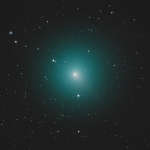 Comet 46P Wirtanen
15.11.2018
Periodic Comet 46P/Wirtanen is now the brightest comet in the night sky, but too faint to be seen by eye. From dark sky sites it could just become naked-eye visible though, as it's 5.4 year long looping orbit takes it closest to Earth and the Sun in mid December.
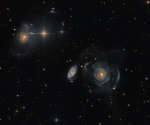 Shell Galaxies in Pisces
27.08.2020
This intergalactic skyscape features a peculiar system of galaxies cataloged as Arp 227 some 100 million light-years distant. Swimming within the boundaries of the constellation Pisces, Arp 227 consists of the two galaxies prominent right of center, the curious shell galaxy NGC 474 and its blue, spiral-armed neighbor NGC 470.
 Planetary Nebula Abell 7
7.03.2025
Very faint planetary nebula Abell 7 is about 1,800 light-years distant. It lies just south of Orion in planet Earth's skies toward the constellation Lepus, The Hare. Surrounded by Milky Way stars...
 APOD: 2025 July 22 Б A Double Detonation Supernova
22.07.2025
Can some supernovas explode twice? Yes, when the first explosion acts like a detonator for the second. This is a leading hypothesis for the cause of supernova remnant (SNR) 0509-67
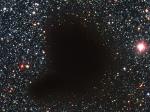 Molecular Cloud Barnard 68
9.04.2006
Where did all the stars go? What used to be considered a hole in the sky is now known to astronomers as a dark molecular cloud. Here, a high concentration of dust and molecular gas absorb practically all the visible light emitted from background stars.
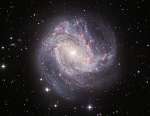 M83: The Thousand Ruby Galaxy
27.09.2008
Big, bright, and beautiful, spiral galaxy M83 lies a mere twelve million light-years away, near the southeastern tip of the very long constellation Hydra. Prominent spiral arms traced by dark dust lanes and blue star clusters lend this galaxy its popular name of the Southern Pinwheel.
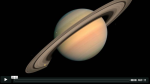 Cassini Approaches Saturn
15.03.2011
What would it look like to approach Saturn in a spaceship? One doesn't have to just imagine -- the Cassini spacecraft did just this in 2004, recording thousands of images along the way, and thousands more since entering orbit.
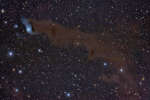 In Wolf s Cave
19.11.2011
The mysterious blue reflection nebula found in catalogs as VdB 152 or Ced 201 really is very faint. It lies at the tip of the long dark nebula Barnard 175 in a dusty complex that has also been called Wolf's Cave.
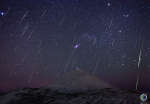 Geminid Meteors over Teide Volcano
17.12.2013
On some nights it rains meteors. Peaking two nights ago, asteroid dust streaked through the dark skies of Earth, showering down during the annual Geminids meteor shower. Astrophotographer Juan Carlos Casado captured the space weather event, as pictured above, in a series of exposures spanning about 2.3 hours using a wide angle lens.
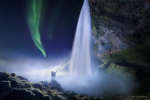 Lucid Dreaming
4.04.2016
Is this the real world? Or is it just fantasy? The truth started with a dream -- a dream that the spectacular Seljarlandsfoss waterfall in southern Iceland could be photographed with a backdrop of an aurora-filled sky. Soon after a promising space weather report, the visionary astrophotographer and his partner sprang into action.
|
January February March April May June July August September |
|||||||||||||||||||||||||||||||||||||||||||||||||