
|
You entered: comet
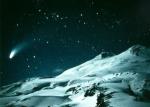 A Hale Bopp Holiday
25.12.1997
Seen from the Pik Terskol Observatory in the northern Caucasus mountains, comet Hale-Bopp and the bright stars of the constellation Perseus hang above the snowy, moon-lit landscape. Although it reminds Northern Hemisphere dwellers of an idyllic Winter scene, this picture was actually recorded in the spring - on April 13th of this year.
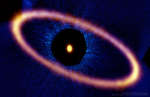 Ice Ring around Nearby Star Fomalhaut
3.10.2017
Why is there a large ice ring around Fomalhaut? This interesting star -- easily visible in the night sky -- lies only about 25 light-years away and is known to be orbited by at least one planet, Dagon, as well as several inner dust disks.
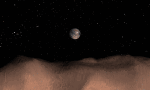 Earth Nears Asteroid Toutatis
20.01.1997
On November 29, 1996 the Earth came within 3.3 million miles of the asteroid Toutatis. Above is a computer simulated picture of this spectacle from the surface of Toutatis (a 2.5 degree field of view looking toward Earth). In Earth's sky, Toutatis appeared only as a faint object moving against a background of stars.
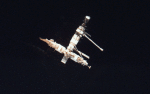 Atlantis Approaches Mir
2.04.1996
Imagine flying though space and approaching the Mir space station. The crew of the Space Shuttle Atlantis did just this in a mission that ended only two days ago. Mir, now 10 years old, is equipped for scientific experiments in astronomy, physics, materials, biology and chemistry.
 A Cosmic Snowball
30.05.1997
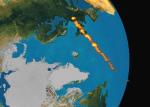
Like cosmic snowballs, fluffy comet-like objects the size of houses and composed mostly of water-ice, may be pummeling planet Earth 5 to 30 times a minute. This controversial theory was originally proposed in 1986 by Dr. Louis Frank (U. Iowa) based on data from NASA's Dynamics Explorer 1.
 An Annotated Leonid
30.11.1998
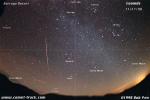
The 1998 Leonids Meteor Shower was perhaps the most photographed meteor event in history. Patient observers saw bright meteors streak across dark skies every few minutes, frequently leaving fading trails stretching across the sky. High above the Anza-Borrego Desert, a meteor was photographed streaking up from the radiant constellation of the Leonids: Leo.
 Skylab Over Earth
10.05.1998
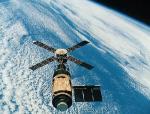
Skylab was an orbiting laboratory launched by a Saturn V rocket in May 1973. Skylab was visited three times by NASA astronauts who sometimes stayed as long as two and a half months. Many scientific tests were performed on Skylab, including astronomical observations in ultraviolet and X-ray light.
 Catching Falling Stardust
21.11.1998
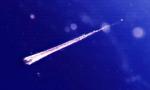
This carrot shaped track is actually little more than 5 hundredths of an inch long. It is the trail of a meteroid through the high-tech substance aerogel exposed to space by the shuttle launched EURECA (European Recoverable Carrier) spacecraft.
 Skylab Over Earth
29.04.2006
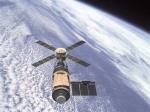
Skylab was an orbiting laboratory launched by a in May 1973. Skylab, pictured above, was visited three times by NASA astronauts who sometimes stayed as long as two and a half months. Many scientific tests were performed on Skylab, including astronomical observations in ultraviolet and X-ray light.
 Skylab Over Earth
28.05.2000
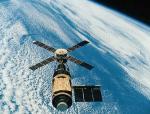
Skylab was an orbiting laboratory launched by a Saturn V rocket in May 1973. Skylab was visited three times by NASA astronauts who sometimes stayed as long as two and a half months. Many scientific tests were performed on Skylab, including astronomical observations in ultraviolet and X-ray light.
|
January February March April May June July August September October |
|||||||||||||||||||||||||||||||||||||||||||||||||