
|
You entered: dark
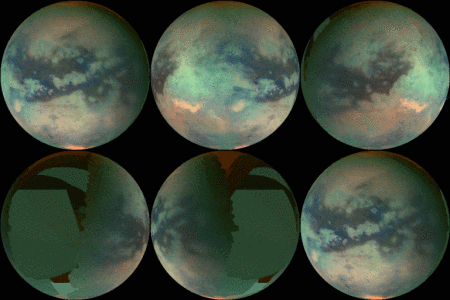 Rotating Titan in Infrared Light
15.02.2006
Titan is one of the strangest places in our Solar System. The only moon known with thick clouds, this unusual satellite of Saturn shows evidence of evaporating lakes created by methane rain. The clouds...
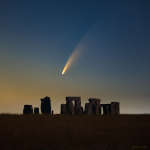 Comet NEOWISE over Stonehenge
14.07.2020
Have you ever seen a comet? Tonight -- and likely the next few nights -- should be a good chance. Go outside just at sunset and look to your northwest. The lower your horizon, the better. Binoculars may help, but if your sky is cloudless and dark, all you should need is your unaided eyes and patience.
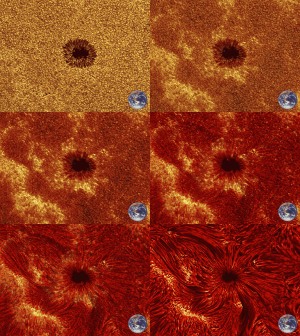 Sunspot Metamorphosis: From Bottom to Top
16.02.2005
Sunspots -- magnets the size of the Earth -- are normally seen flat on the Sun. The above digital metamorphosis, however, shows a sunspot as it appears at increasing heights, effectively in three dimensions. The above...
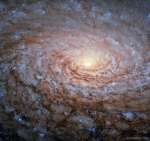 M63: The Sunflower Galaxy from Hubble
9.11.2016
One of the bright spiral galaxies visible in the north sky is M63, the Sunflower Galaxy. M63, also catalogued as NGC 5055, can be found with a small telescope toward the constellation of Hunting Dogs (Canes Venatici).
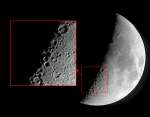 The Lunar X
10.12.2016
The striking X appearing in this lunarscape is easily visible in binoculars or a small telescope. Yet, not too many have seen it. The catch is this lunar X is fleeting, only apparent in the hours before the Moon's first quarter phase.
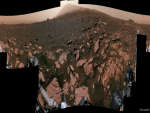 Ancient Ogunquit Beach on Mars
8.05.2017
This was once a beach -- on ancient Mars. The featured 360-degree panorama, horizontally compressed, was taken by the robotic Curiosity rover currently exploring the red planet. Named Ogunquit Beach after its terrestrial counterpart, evidence...
 The Horsehead Nebula
27.12.2017
One of the most identifiable nebulae in the sky, the Horsehead Nebula in Orion, is part of a large, dark, molecular cloud. Also known as Barnard 33, the unusual shape was first discovered on a photographic plate in the late 1800s.
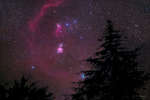 Orion Pines
16.04.2022
Taken with a camera fixed to a tripod, many short exposures were aligned with the stars to unveil this beautiful, dark night sky. Captured near the rural village of Albany`a at the northeastern corner of Spain, the three stars of Orion's belt stretch across top center in the starry frame.
 APOD: 2024 June 2 Б Rotating Moon from LRO
2.06.2024
No one, presently, sees the Moon rotate like this. That's because the Earth's moon is tidally locked to the Earth, showing us only one side. Given modern digital technology, however, combined with many detailed images returned by the Lunar Reconnaissance Orbiter (LRO), a high resolution virtual Moon rotation movie has been composed.
 MACS 1206: A Galaxy Cluster Gravitational Len
17.10.2011
It is difficult to hide a galaxy behind a cluster of galaxies. The closer cluster's gravity will act like a huge lens, pulling images of the distant galaxy around the sides and greatly distorting them.
|
January February March April May June July August September |
|||||||||||||||||||||||||||||||||||||||||||||||||