
|
You entered: dark
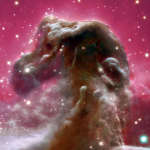 The Horsehead Nebula from Blue to Infrared
28.07.2014
One of the most identifiable nebulae in the sky, the Horsehead Nebula in Orion, is part of a large, dark, molecular cloud. Also known as Barnard 33, the unusual shape was first discovered on a photographic plate in the late 1800s.
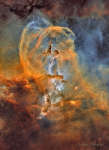 APOD: 2026 July 20 Б NGC 3576: The Statue of Liberty Nebula
20.07.2026
What's happening in the Statue of Liberty nebula? Bright stars and interesting molecules are forming and being liberated. The complex nebula resides in the star forming region called RCW 57, and besides the iconic monument, to some looks like a flying superhero or a weeping angel.
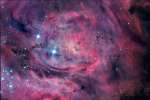 M8: The Lagoon Nebula
5.08.2010
This beautiful cosmic cloud is a popular stop on telescopic tours of the constellation Sagittarius. Eighteenth century cosmic tourist Charles Messier cataloged the bright nebula as M8. Modern day astronomers recognize the Lagoon Nebula as an active stellar nursery about 5,000 light-years distant, in the direction of the center of our Milky Way Galaxy.
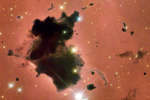 Thackerays Globules
28.12.2008
Rich star fields and glowing hydrogen gas silhouette dense, opaque clouds of interstellar gas and dust in this Hubble Space Telescope close-up of IC 2944, a bright star forming region in Centaurus, 5,900 light-years away. The largest of these dark globules, first spotted by South African astronomer A. D.
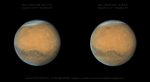 Stereo Mars
3.12.2022
Mars looks sharp in these two rooftop telescope views captured in late November from Singapore, planet Earth. At the time, Mars was about 82 million kilometers from Singapore and approaching its opposition, opposite the Sun in planet Earth's sky on December 8.
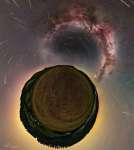 Perseids Over a Little Planet
12.08.2026
It looks like a view from the Little Prince's planet. The featured image is a throwback to the 2024 Perseid meteor shower, surrounded in this projection by the Bieszczady Mountains in Poland. Visible...
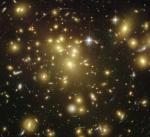 Galaxy Cluster Abell 1689 Warps Space
27.06.2004
Two billion light-years away, galaxy cluster Abell 1689 is one of the most massive objects in the Universe. In this view from the Hubble Space Telescope's Advanced Camera for Surveys, Abell 1689...
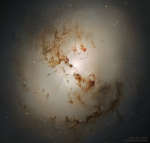 Central NGC 1316: After Galaxies Collide
26.01.2021
How did this strange-looking galaxy form? Astronomers turn detectives when trying to figure out the cause of unusual jumbles of stars, gas, and dust like NGC 1316. Inspection indicates that NGC 1316 is an enormous elliptical galaxy that somehow includes dark dust lanes usually found in a spiral galaxy.
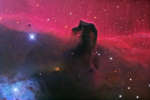 The Horsehead Nebula in Orion
26.11.2008
One of the most identifiable nebulae in the sky, the Horsehead Nebula in Orion, is part of a large, dark, molecular cloud. Also known as Barnard 33, the unusual shape was first discovered on a photographic plate in the late 1800s.
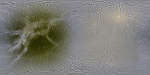 The Map of Dione
6.11.2014
This cylindrical projection global map is one of six new color maps of Saturn's midsized icy moons, constructed using 10 years of image data from the Cassini spacecraft. Discovered by Cassini (the astronomer) in 1684, Dione is about 1,120 kilometers across.
|
January February March April May June July August September |
|||||||||||||||||||||||||||||||||||||||||||||||||