
|
You entered: gas
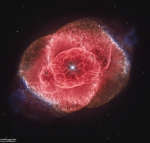 In the Center of the Cats Eye Nebula
9.07.2022
Three thousand light-years away, a dying star throws off shells of glowing gas. This image from the Hubble Space Telescope reveals the Cat's Eye Nebula (NGC 6543), to be one of the most complex planetary nebulae known.
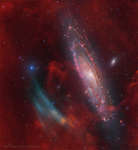 APOD: 2023 January 17 Б Unexpected Clouds Toward the Andromeda Galaxy
16.01.2023
Why are there oxygen-emitting arcs near the direction of the Andromeda galaxy? No one is sure. The gas arcs, shown in blue, were discovered and first confirmed by amateur astronomers just last year.
 APOD: 2025 September 8 Б IRAS 04302: Butterfly Disk Planet Formation
7.09.2025
This butterfly can hatch planets. The nebula fanning out from the star IRAS 04302+2247 may look like the wings of a butterfly, while the vertical brown stripe down the center may look like the butterfly's body -- but together they indicate an active planet-forming system.
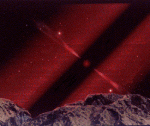 Planet Near a Galaxy Core
5.05.1996
What would the night sky look like if you lived on a planet near the center of a galaxy? Now imagine that this galaxy houses a black hole billions of times more massive than a star. From this spectacular vantage point, the sky might look like the above illustration.
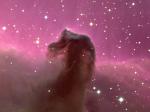 The Horsehead Nebula
27.05.2007
One of the most identifiable nebulae in the sky, the Horsehead Nebula in Orion, is part of a large, dark, molecular cloud. Also known as Barnard 33, the unusual shape was first discovered on a photographic plate in the late 1800s.
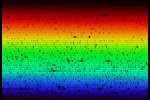 All the Colors of the Sun
2.10.2013
It is still not known why the Sun's light is missing some colors. Here are all the visible colors of the Sun, produced by passing the Sun's light through a prism-like device.
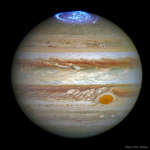 Aurorae on Jupiter
10.07.2016
Jupiter has aurorae. Like Earth, the magnetic field of the gas giant funnels charged particles released from the Sun onto the poles. As these particles strike the atmosphere, electrons are temporarily knocked away from existing gas molecules. Electric force attracts these electrons back. As the electrons recombine to remake neutral molecules, auroral light is emitted.
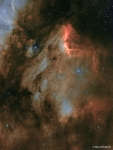 IC 5070: A Dusty Pelican in the Swan
18.11.2016
The recognizable profile of the Pelican Nebula soars nearly 2,000 light-years away in the high flying constellation Cygnus, the Swan. Also known as IC 5070, this interstellar cloud of gas and dust...
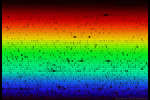 The Suns Spectrum with its Missing Colors
25.09.2018
It is still not known why the Sun's light is missing some colors. Here are all the visible colors of the Sun, produced by passing the Sun's light through a prism-like device.
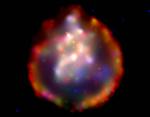 72.6: Oxygen Supply
28.05.2003
A supernova explosion, a massive star's inevitable and spectacular demise, blasts back into space debris enriched in the heavy elements forged in its stellar core. Incorporated into future stars and planets, these are the elements ultimately necessary for life.
|
January February March April May June July August September October |
|||||||||||||||||||||||||||||||||||||||||||||||||