
|
You entered: gas
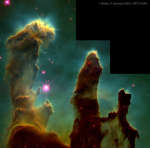 M16: Pillars of Star Creation
5.12.2020
These dark pillars may look destructive, but they are creating stars. This pillar-capturing image of the inside of the Eagle Nebula, taken with the Hubble Space Telescope in 1995, shows evaporating gaseous globules (EGGs) emerging from pillars of molecular hydrogen gas and dust.
 APOD: 2023 October 31 Б Halloween and the Wizard Nebula
30.10.2023
Halloween's origin is ancient and astronomical. Since the fifth century BC, Halloween has been celebrated as a cross-quarter day, a day halfway between an equinox (equal day / equal night) and a solstice (minimum day / maximum night in the northern hemisphere).
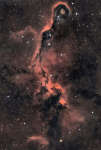 APOD: 2026 August 20 Б The Elephant s Trunk in Cepheus
19.08.2026
Like an illustration in a galactic Just So Story, the Elephant's Trunk Nebula winds through the emission region and young star cluster complex IC 1396, in the high and far off constellation of Cepheus. Also known as vdB 142, this cosmic elephant's trunk is over 20 light-years long.
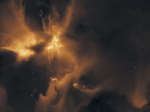 A Particle Beam Jet forms HH 24
4.02.2014
If you visit HH 24, don't go near the particle beam jet. This potential future travel advisory might be issued because the powerful jet likely contains electrons and protons moving hundreds of kilometers per second.
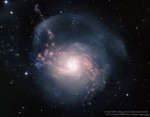 NGC 3310: A Starburst Spiral Galaxy
29.02.2016
The party is still going on in spiral galaxy NGC 3310. Roughly 100 million years ago, NGC 3310 likely collided with a smaller galaxy causing the large spiral galaxy to light up with a tremendous burst of star formation.
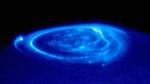 A Close Up of Aurora on Jupiter
18.12.2000
Jupiter has aurorae. Like Earth, the magnetic field of the gas giant funnels charged particles released from the Sun onto the poles. As these particles strike the atmosphere, electrons are temporarily knocked away from existing gas molecules. Electric force attracts these electrons back. As the electrons recombine to remake neutral molecules, auroral light is emitted.
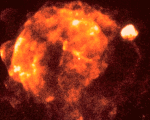 Vela Supernova Remnant in X-ray
12.06.1996
What happens when a star explodes? A huge fireball of hot gas shoots out in all directions. When this gas slams into the existing interstellar medium, it heats up so much it glows in X-rays.
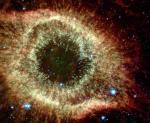 Infrared Helix
11.01.2006
Over six hundred light years from Earth, in the constellation Aquarius, a sun-like star is dying. Its last few thousand years have produced the Helix Nebula (NGC 7293), a well studied and nearby example of a Planetary Nebula, typical of this final phase of stellar evolution.
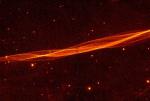 Filaments In The Cygnus Loop
26.04.2000
Subtle and delicate in appearance, these are filaments of shocked interstellar gas -- part of the expanding blast wave from a violent stellar explosion. Recorded in November 1997 with the Wide Field and Planetary Camera 2 onboard the Hubble Space Telescope, the picture is a closeup of a supernova remnant known as the Cygnus Loop.
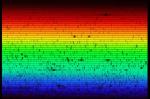 All the Colors of the Sun
24.06.2007
It is still not known why the Sun's light is missing some colors. Shown above are all the visible colors of the Sun, produced by passing the Sun's light through a prism-like device.
|
January February March April May June July August September October |
|||||||||||||||||||||||||||||||||||||||||||||||||