
|
You entered: gas
 APOD: 2023 September 19 Б HH 211: Jets from a Forming Star
19.09.2023
Do stars always create jets as they form? No one is sure. As a gas cloud gravitationally contracts, it forms a disk that can spin too fast to continue contracting into a protostar. Theorists hypothesize that this spin can be reduced by expelling jets.
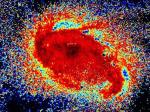 Comet-like Clouds in the Cartwheel Galaxy
28.11.1996
In a cartwheel-shaped galaxy far, far away, huge comet-shaped clouds of gas have been discovered racing through the nucleus at about 700,000 miles per hour. The aptly named Cartwheel Galaxy is actually about 500 million light years distant, its suggestive shape created by a head-on collision with a smaller galaxy.
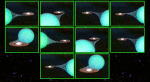 Black Hole Signature From Advective Disks
15.01.1997
What does a black hole look like? If alone, a black hole would indeed appear quite black, but many black hole candidates are part of binary star systems. So how does a black hole binary system look different from a neutron star binary system? The above drawings indicate it is difficult to tell!
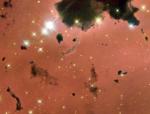 Thackerays Globules
16.08.2003
Rich star fields and glowing hydrogen gas silhouette dense, opaque clouds of interstellar gas and dust in this Hubble Space Telescope close-up of IC 2944, a bright star forming region in Centaurus, 5,900 light-years away. The largest of these dark globules, first spotted by South African astronomer A. D.
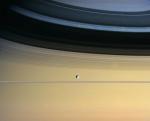 A Year at Saturn
31.12.2005
Arriving at Saturn in July of 2004, the Cassini spacecraft has now spent a year and a half exploring the magnificent rings and moons of the distant gas giant. The year 2005 began with Cassini's Huygens probe landing on Saturn's large moon Titan.
 A Lion in Orion
7.03.2022
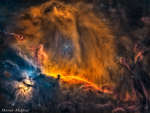
Yes, but can you see the lion? A deep exposure shows the famous dark indentation that looks like a horse's head, visible just left and below center, and known unsurprisingly as the Horsehead Nebula. The Horsehead Nebula (Barnard 33) is part of a vast complex of dark absorbing dust and bright glowing gas.
 Hydrogen Clouds of M33
30.01.2025
Gorgeous spiral galaxy Messier 33 seems to have more than its fair share of glowing hydrogen gas. A prominent member of the local group of galaxies, M33 is also known as the Triangulum Galaxy and lies a mere 3 million light-years away.
 APOD: 2025 April 20 Б The Orion Nebula in Visible and Infrared
20.04.2025
The Great Nebula in Orion is a colorful place. Visible to the unaided eye, it appears as a small fuzzy patch in the constellation of Orion. Long exposure, multi-wavelength images like this, however, show the Orion Nebula to be a busy neighborhood of young stars, hot gas, and dark dust.
 APOD: 2026 January 19 Б CTB 1: The Medulla Nebula
19.01.2026
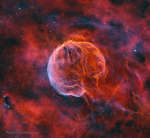
What powers this unusual nebula? CTB 1 is the expanding gas shell that was left when a massive star toward the constellation of Cassiopeia exploded about 10,000 years ago. The star likely detonated when it ran out of elements, near its core, that could create stabilizing pressure with nuclear fusion.
 New Stars Destroying NGC 1748
3.04.2001
NGC 1748 cannot contain all the new stars it has formed. The young stars, the most massive of which are bright blue, emit so much energy they are pushing out and dispersing the gas and dust that comprise this star forming nebula.
|
January February March April May June July August September October |
|||||||||||||||||||||||||||||||||||||||||||||||||