
|
You entered: hydrogen
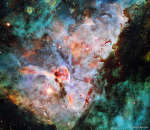 Clouds of the Carina Nebula
16.05.2016
What forms lurk in the mists of the Carina Nebula? The dark ominous figures are actually molecular clouds, knots of molecular gas and dust so thick they have become opaque. In comparison, however, these clouds are typically much less dense than Earth's atmosphere.
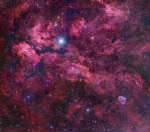 Central Cygnus Skyscape
22.03.2017
In cosmic brush strokes of glowing hydrogen gas, this beautiful skyscape unfolds across the plane of our Milky Way Galaxy near the northern end of the Great Rift and the center of the constellation Cygnus the Swan. A 36 panel mosaic of telescopic image data, the scene spans about six degrees.
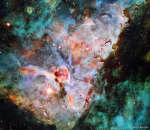 Clouds of the Carina Nebula
2.05.2021
What forms lurk in the mists of the Carina Nebula? The dark ominous figures are actually molecular clouds, knots of molecular gas and dust so thick they have become opaque. In comparison, however, these clouds are typically much less dense than Earth's atmosphere.
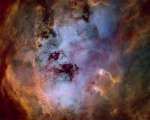 The Tadpole Nebula in Gas and Dust
19.12.2022
What's causing the commotion in the Tadpole Nebula? Star formation. Dusty emission in the Tadpole Nebula, IC 410, lies about 12,000 light-years away in the northern constellation of the Charioteer (Auriga).
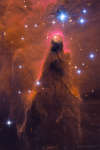 APOD: 2023 January 10 Б NGC 2264: The Cone Nebula
10.01.2023
Stars are forming in the gigantic dust pillar called the Cone Nebula. Cones, pillars, and majestic flowing shapes abound in stellar nurseries where clouds of gas and dust are sculpted by energetic winds from newborn stars. The Cone Nebula, a well-known example, lies within the bright galactic star-forming region NGC 2264.
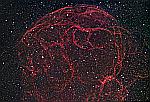 Simeis 147: Supernova Remnant
24.03.2005
It's easy to get lost following the intricate filaments in this detailed image of faint supernova remnant Simeis 147. Seen towards the constellation Taurus it covers nearly 3 degrees (6 full moons) on the sky corresponding to a width of 150 light-years at the stellar debris cloud's estimated distance of 3,000 light-years.
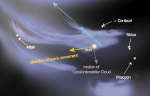 The Local Fluff
29.08.2010
The stars are not alone. In the disk of our Milky Way Galaxy about 10 percent of visible matter is in the form of gas, called the interstellar medium (ISM). The ISM is not uniform, and shows patchiness even near our Sun.
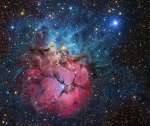 A Beautiful Trifid
13.05.2011
The beautiful Trifid Nebula is a cosmic study in colorful contrasts. Also known as M20, it lies about 5,000 light-years away toward the nebula rich constellation Sagittarius. A star forming region...
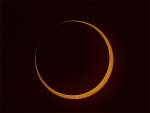 Cape York Annular Eclipse
11.05.2013
This week the shadow of the New Moon fell on planet Earth, crossing Queensland's Cape York in northern Australia ... for the second time in six months. On the morning...
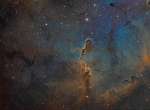 The Elephant s Trunk in IC 1396
26.07.2013
Like an illustration in a galactic Just So Story, the Elephant's Trunk Nebula winds through the emission nebula and young star cluster complex IC 1396, in the high and far off constellation of Cepheus. Of course, the cosmic elephant's trunk is over 20 light-years long.
|
January February March April May June July August September October |
|||||||||||||||||||||||||||||||||||||||||||||||||