
|
You entered: hydrogen
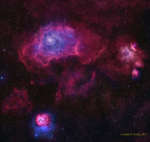 A Sagittarius Triplet
27.07.2017
These three bright nebulae are often featured on telescopic tours of the constellation Sagittarius and the crowded starfields of the central Milky Way. In fact, 18th century cosmic tourist Charles Messier cataloged two of them; M8, the large nebula above and left of center, and colorful M20 near the bottom of the frame.
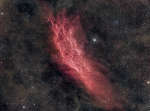 NGC 1499: The California Nebula
22.10.2022
Drifting through the Orion Arm of the spiral Milky Way Galaxy, this cosmic cloud by chance echoes the outline of California on the west coast of the United States. Our own Sun also lies within the Milky Way's Orion Arm, only about 1,500 light-years from the California Nebula.
 APOD: 2025 July 29 Б A Helix Nebula Deep Field
29.07.2025
Is the Helix Nebula looking at you? No, not in any biological sense, but it does look quite like an eye. The Helix Nebula is so named because it also appears that you are looking down the axis of a helix.
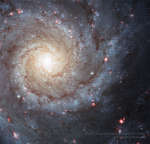 APOD: 2026 August 30 Б M74: A Grand Design Spiral
30.08.2026
If not the most grand, then this spiral galaxy is at least one of the most photogenic. An island universe of about 100 billion stars, 32 million light-years away toward the constellation Pisces, M74 presents a gorgeous face-on view.
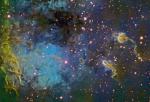 The Tadpoles of IC 410
11.01.2006
This close-up view shows a portion of otherwise faint emission nebula IC 410 in striking false-colors. It also shows two remarkable denizens of the glowing gas cloud at the right - the "tadpoles" of IC 410. The picture is a composite of images taken through narrow band filters intended to trace atoms in the nebula.
 Dark Sun Sizzling
10.07.2006
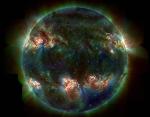
Is this our Sun? Yes. Even on a normal day, our Sun is sizzling ball of seething hot gas. Unpredictably, regions of strong and tangled magnetic fields arise, causing sunspots and bright active regions. The Sun's surface bubbles as hot hydrogen gas streams along looping magnetic fields.
 Exploring the Ring
18.09.2008
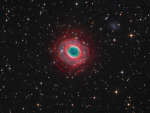
A familiar sight for northern hemisphere astronomers, the Ring Nebula (M57) is some 2,000 light-years away in the musical constellation Lyra. The central ring is about one light-year across, but this remarkably deep...
 Young Suns of NGC 7129
3.10.2008
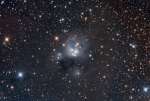
Young suns still lie within dusty NGC 7129, some 3,000 light-years away toward the royal constellation Cepheus. While these stars are at a relatively tender age, only about a million years old, it is likely that our own Sun formed in a similar stellar nursery some five billion years ago.
 Simeis 147: Supernova Remnant
12.02.2011
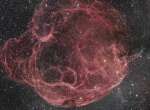
It's easy to get lost following the intricate filaments in this detailed mosaic image of faint supernova remnant Simeis 147. Also cataloged as Sh2-240 and seen towards the constellation Taurus, it covers nearly 3 degrees (6 full moons) on the sky.
 WR32 and Interstellar Clouds in Carina
8.02.2021
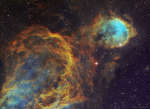
Stars can be like artists. With interstellar gas as a canvas, a massive and tumultuous Wolf-Rayet star has created the picturesque ruffled half-circular filaments called WR32, on the image left. Additionally, the winds...
|
January February March April May June July August September October |
|||||||||||||||||||||||||||||||||||||||||||||||||