
|
You entered: hydrogen
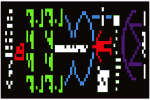 A Message From Earth
19.02.2012
What are these Earthlings trying to tell us? The above message was broadcast from Earth towards the globular star cluster M13 in 1974. During the dedication of the Arecibo Observatory - still the largest single radio telescope in the world - a string of 1's and 0's representing the above diagram was sent.
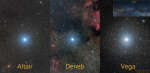 Stars of a Summer Triangle
27.06.2015
Rising at the start of a northern summer's night, these three bright stars form the familiar asterism known as the Summer Triangle. Altair, Deneb, and Vega are the alpha stars of their respective constellations, Aquila, Cygnus, and Lyra, nestled near the Milky Way.
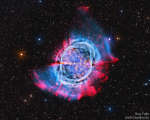 M27: The Dumbbell Nebula
12.07.2021
What will become of our Sun? The first hint of our Sun's future was discovered inadvertently in 1764. At that time, Charles Messier was compiling a list of diffuse objects not to be confused with comets.
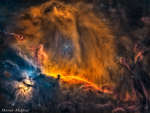 A Lion in Orion
7.03.2022
Yes, but can you see the lion? A deep exposure shows the famous dark indentation that looks like a horse's head, visible just left and below center, and known unsurprisingly as the Horsehead Nebula. The Horsehead Nebula (Barnard 33) is part of a vast complex of dark absorbing dust and bright glowing gas.
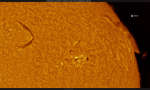 Filaprom on the Western Limb
24.06.2022
A solar filament is an enormous stream of incandescent plasma suspended above the active surface of the Sun by looping magnetic fields. Seen against the solar disk it looks dark only because it's a little cooler, and so slightly dimmer, than the solar photosphere.
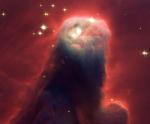 Cone Nebula Close Up
3.05.2002
Cones, pillars, and majestic flowing shapes abound in stellar nurseries where natal clouds of gas and dust are buffeted by energetic winds from newborn stars. A well-known example, the Cone Nebula within the bright galactic star-forming region NGC 2264, was captured in this close-up view from the Hubble Space Telescope's newest camera.
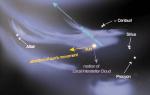 The Local Interstellar Cloud
11.04.2000
The stars are not alone. In the disk of our Milky Way Galaxy about 10 percent of visible matter is in the form of gas, called the interstellar medium (ISM). The ISM is not uniform, and shows patchiness even near our Sun.
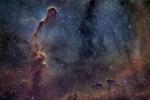 The Elephant s Trunk in IC 1396
18.10.2007
Like an illustration in a galactic Just So Story, the Elephant's Trunk Nebula winds through the emission nebula and young star cluster complex IC 1396, in the high and far off constellation of Cepheus. Of course, this cosmic elephant's trunk is over 20 light-years long.
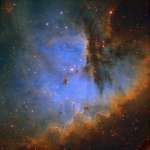 NGC 281
10.12.2008
Look through the cosmic cloud cataloged as NGC 281 and it's almost easy to miss stars of the open cluster IC 1590. But, formed within the nebula, that cluster's young, massive stars ultimately power the pervasive nebular glow.
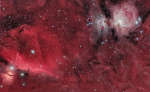 Horsehead and Orion Nebulas
5.10.2010
The dark Horsehead Nebula and the glowing Orion Nebula are contrasting cosmic vistas. Adrift 1,500 light-years away in one of the night sky's most recognizable constellations, they appear in opposite corners of the above stunning mosaic.
|
January February March April May June July August September October |
|||||||||||||||||||||||||||||||||||||||||||||||||