
|
You entered: hydrogen
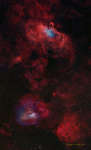 The Eagle and The Swan
23.08.2017
The Eagle Nebula and the Swan Nebula span this broad starscape, a telescopic view toward the Sagittarius spiral arm and the center of our Milky Way galaxy. The Eagle, also known as M16, is at top and M17, the Swan, at bottom of the frame showing the cosmic clouds as brighter regions of active star-formation.
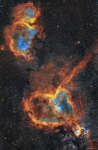 The Heart and Soul Nebulas
14.01.2019
Is the heart and soul of our Galaxy located in Cassiopeia? Possibly not, but that is where two bright emission nebulas nicknamed Heart and Soul can be found. The Heart Nebula, officially dubbed IC 1805 and visible in the featured image on the bottom right, has a shape reminiscent of a classical heart symbol.
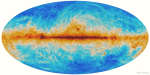 Magnetic Streamlines of the Milky Way
16.06.2020
What role do magnetic fields play in interstellar physics? Analyses of observations by ESA's Planck satellite of emission by small magnetically-aligned dust grains reveal previously unknown magnetic field structures in our Milky Way Galaxy -- as shown by the curvy lines in the featured full-sky image.
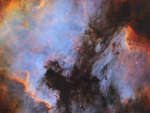 North America and the Pelican
15.09.2021
Fans of our fair planet might recognize the outlines of these cosmic clouds. On the left, bright emission outlined by dark, obscuring dust lanes seems to trace a continental shape, lending the popular name North America Nebula to the emission region cataloged as NGC 7000.
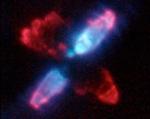 Shells in the Egg Nebula
26.06.1999
The Egg Nebula is taking a beating. Like a baby chick pecking its way out of an egg, the star in the center of the Egg Nebula is casting away shells of gas and dust as it slowly transforms itself into a white dwarf star.
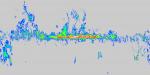 Milky Way Molecule Map
30.04.1997
Where are the Milky Way's gas clouds and where are they going? Stars form in gas clouds, and the motion of gas clouds tell us about the size and rotation speed of our own Milky Way Galaxy.
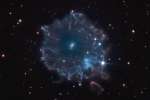 Halo of the Cat s Eye
31.08.2012
The Cat's Eye Nebula (NGC 6543) is one of the best known planetary nebulae in the sky. Its haunting symmetries are seen in the very central region of this tantalizing image, processed to reveal the enormous but extremely faint halo of gaseous material, about 6 light-years across, which surrounds the brighter, familiar planetary nebula.
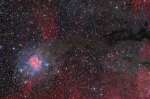 Cocoon Nebula Wide Field
13.09.2012
In this crowded starfield covering over 2 degrees within the high flying constellation Cygnus, the eye is drawn to the Cocoon Nebula. A compact star forming region, the cosmic Cocoon punctuates a long trail of obscuring interstellar dust clouds.
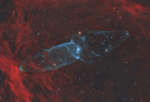 Ou4: The Giant Squid Nebula
11.10.2022
A mysterious squid-like cosmic cloud, this nebula is very faint, but also very large in planet Earth's sky. In the image, composed with 30 hours of narrowband image data, it spans nearly three full moons toward the royal constellation Cepheus.
 APOD: 2025 December 17 Б W5: The Soul Nebula
16.12.2025
Stars are forming in the Soul of the Queen of Aethopia. More specifically, a large star forming region called the Soul Nebula can be found in the direction of the constellation Cassiopeia, whom Greek mythology credits as the vain wife of a King who long ago ruled lands surrounding the upper Nile river.
|
January February March April May June July August September October |
|||||||||||||||||||||||||||||||||||||||||||||||||