
|
You entered: hydrogen
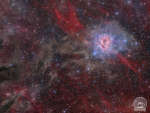 Cocoon Nebula Deep Field
18.09.2018
Inside the Cocoon Nebula is a newly developing cluster of stars. The cosmic Cocoon on the upper right also punctuates a long trail of obscuring interstellar dust clouds to its left. Cataloged...
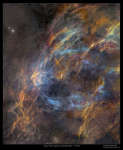 Cygnus Shell Supernova Remnant W63
1.11.2018
The ghost of a long-dead star, the W63 supernova remnant shines like a faint cosmic smoke-ring along the plane of the Milky Way galaxy toward the northern constellation Cygnus the swan. Its wraithlike appearance is traced against the region's rich complex of interstellar clouds and dust by an eerie blue glow.
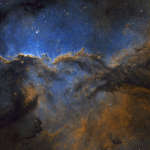 NGC 6188: The Dragons of Ara
6.11.2018
Dark shapes with bright edges winging their way through dusty NGC 6188 are tens of light-years long. The emission nebula is found near the edge of an otherwise dark large molecular cloud in the southern constellation Ara, about 4,000 light-years away.
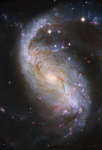 NGC 1672: Barred Spiral Galaxy from Hubble
5.04.2020
Many spiral galaxies have bars across their centers. Even our own Milky Way Galaxy is thought to have a modest central bar. Prominently barred spiral galaxy NGC 1672, featured here, was captured in spectacular detail in an image taken by the orbiting Hubble Space Telescope.
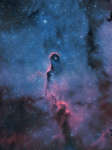 The Elephant's Trunk Nebula in Cepheus
31.07.2020
Like an illustration in a galactic Just So Story, the Elephant's Trunk Nebula winds through the emission nebula and young star cluster complex IC 1396, in the high and far off constellation of Cepheus. Also known as vdB 142, the cosmic elephant's trunk is over 20 light-years long.
 APOD: 2025 March 18 Б LDN 1235: The Shark Nebula
17.03.2025
There is no sea on Earth large enough to contain the Shark nebula. This predator apparition poses us no danger as it is composed only of interstellar gas and dust. Dark dust like that featured here is somewhat like cigarette smoke and created in the cool atmospheres of giant stars.
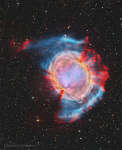 APOD: 2026 June 22 Б M27: The Dumbbell Nebula
21.06.2026
Is this what will become of our Sun? Quite possibly. The first hint of our Sun's future was discovered inadvertently in 1764. At that time, Charles Messier was compiling a list of diffuse objects not to be confused with comets.
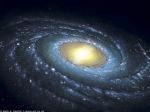 Milky Way Illustrated
3.01.2005
What does our Milky Way Galaxy look like from afar? Since we are stuck inside, and since opaque dust truncates our view in visible light, nobody knows for sure. Drawn above, however, is a good guess based on many different types of observations.
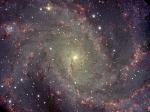 NGC 6946: The Fireworks Galaxy
24.01.2005
Why is this galaxy so active? Nearby spiral galaxy NGC 6946 is undergoing a tremendous burst of star formation with no obvious cause. In many cases spirals light up when interacting with another galaxy, but NGC 6946 appears relatively isolated in space.
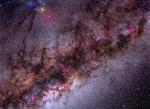 Our Galaxy in Stars, Gas, and Dust
27.09.1999
The disk of our Milky Way Galaxy is home to hot nebulae, cold dust, and billions of stars. The red nebulae visible in the above contrast-enhanced picture are primarily emission nebulae, glowing clouds of hydrogen gas heated by nearby, bright, young stars.
|
January February March April May June July August September October |
|||||||||||||||||||||||||||||||||||||||||||||||||