
|
You entered: hydrogen
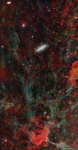 The Deep Sky Toward Andromeda
8.09.2021
What surrounds the Andromeda galaxy? Out in space, Andromeda (M31) is closely surrounded by several small satellite galaxies, and further out it is part of the Local Group of Galaxies -- of which our Milky Way galaxy is also a member.
 APOD: 2025 March 10 Б NGC 1499: The California Nebula
10.03.2025
Could Queen Calafia's mythical island exist in space? Perhaps not, but by chance the outline of this molecular space cloud echoes the outline of the state of California, USA. Our Sun has its home within the Milky Way's Orion Arm, only about 1,000 light-years from the California Nebula.
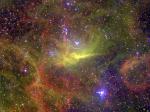 Nebulas Surrounding Wolf Rayet Binary
BAT99 49
Nebulas Surrounding Wolf Rayet Binary
BAT99 49
21.04.2004
How could two young stars power these colorful interstellar gas clouds? Although hidden by thick dust, the stars spew forceful ions and energetic radiation that cause the clouds to fragment and light up.
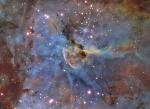 Eta and Keyhole in the Carina Nebula
16.03.2006
South is toward the top in this colorful close-up view of the Great Carina Nebula (NGC 3372), famous star-forming region of the southern sky. Covering an area surrounding the dusty Keyhole Nebula (NGC 3324)...
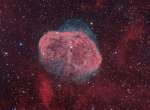 NGC 6888: The Crescent Nebula
13.08.2008
NGC 6888, also known as the Crescent Nebula, is a cosmic bubble about 25 light-years across, blown by winds from its central, bright, massive star. This beautiful telescopic view combines a composite color image with narrow band data that isolates light from hydrogen and oxygen atoms in the wind-blown nebula.
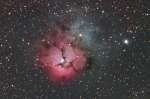 A Beautiful Trifid
30.05.2009
The beautiful Trifid Nebula is a colorful study in cosmic contrasts. Also known as M20, it lies about 5,000 light-years away toward the nebula rich constellation Sagittarius. A star forming region...
 The Light, Dark, and Dusty Trifid
10.08.2024
Messier 20, popularly known as the Trifid Nebula, lies about 5,000 light-years away toward the nebula rich constellation Sagittarius. A star forming region in the plane of our galaxy, the Trifid does illustrate...
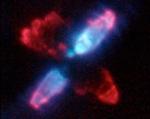 Shells in the Egg Nebula
20.05.1997
The Egg Nebula is taking a beating. Like a baby chick pecking its way out of an egg, the star in the center of the Egg Nebula is casting away shells of gas and dust as it slowly transforms itself into a white dwarf star.
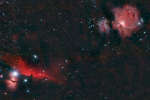 Horsehead and Orion Nebulae
10.03.2009
Adrift 1,500 light-years away in one of the night sky's most recognizable constellations, the glowing Orion Nebula and the dark Horsehead Nebula are contrasting cosmic vistas. They appear in opposite corners of this stunning mosaic taken with a digital camera attached to a small telescope.
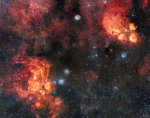 NGC 6357: The Lobster Nebula
7.02.2017
Why is the Lobster Nebula forming some of the most massive stars known? No one is yet sure. Near the more obvious Cat's Paw nebula on the upper right, the Lobster Nebula...
|
January February March April May June July August September October |
|||||||||||||||||||||||||||||||||||||||||||||||||